You may want to refer to several videos for this one if you’re not watching. the video version of this episode. One that isn’t mentioned but might be of interest is a 1940-49 video on whaling. I
With my deep thanks to: Mystic Seaport, Nantucket Whaling Museum, and Silas J. Costello who gave more clarity in his essay than pretty much everywhere else.
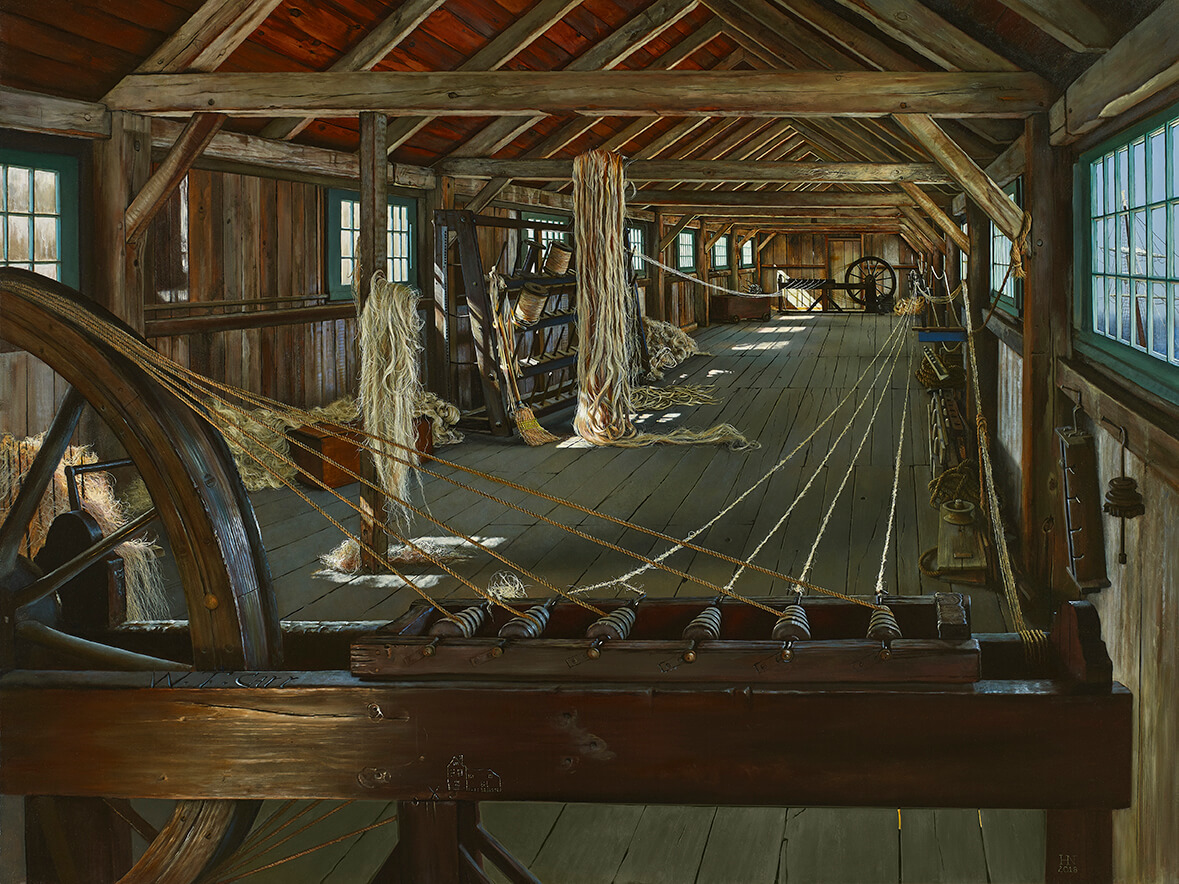
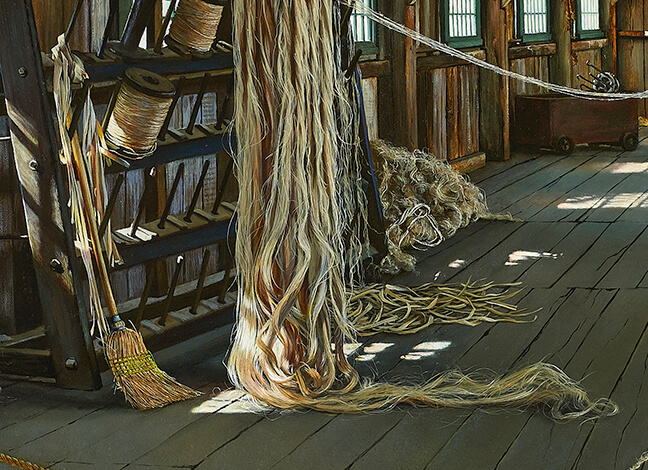
Spinning loft at Mystic Seaport

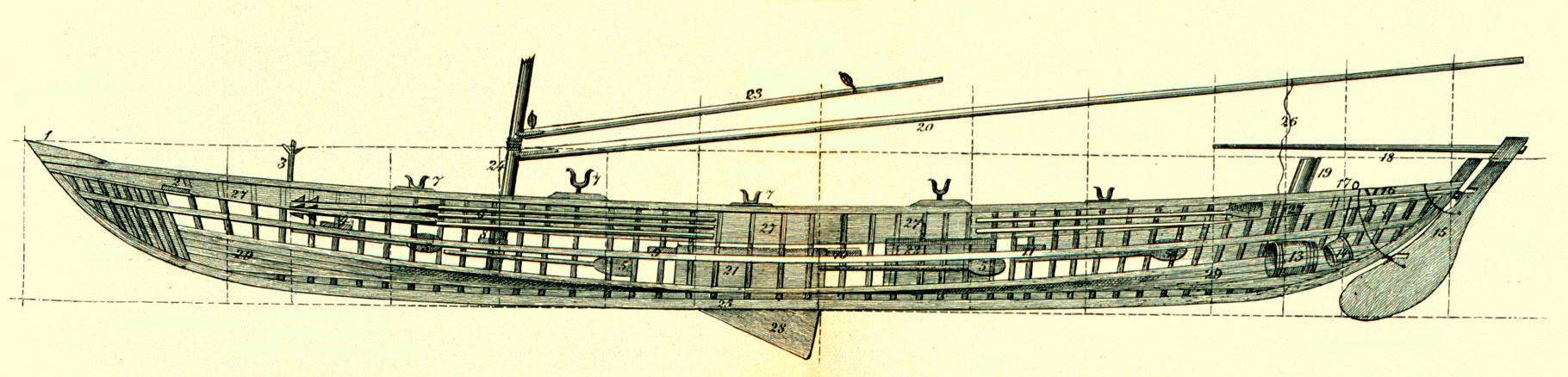
Contents
CHAPTER 60. The Line. Footnotes
CHAPTER 60. The Line.
With reference to the whaling scene shortly to be described, as well as for the better understanding of all similar scenes elsewhere presented, I have here to speak of the magical, sometimes horrible whale-line.
The line originally used in the fishery was of the best hemp,1 slightly vapored with tar, not impregnated with it, as in the case of ordinary ropes; for while tar, as ordinarily used, makes the hemp more pliable to the rope-maker, and also renders the rope itself more convenient to the sailor for common ship use; yet, not only would the ordinary quantity too much stiffen the whale-line for the close coiling to which it must be subjected; but as most seamen are beginning to learn, tar in general by no means adds to the rope’s durability or strength, however much it may give it compactness and gloss.
Of late years the Manilla rope2 has in the American fishery almost entirely superseded hemp as a material for whale-lines; for, though not so durable as hemp, it is stronger, and far more soft and elastic; and I will add (since there is an æsthetics in all things), is much more handsome and becoming to the boat, than hemp. Hemp is a dusky, dark fellow, a sort of Indian; but Manilla is as a golden-haired Circassian3 to behold.
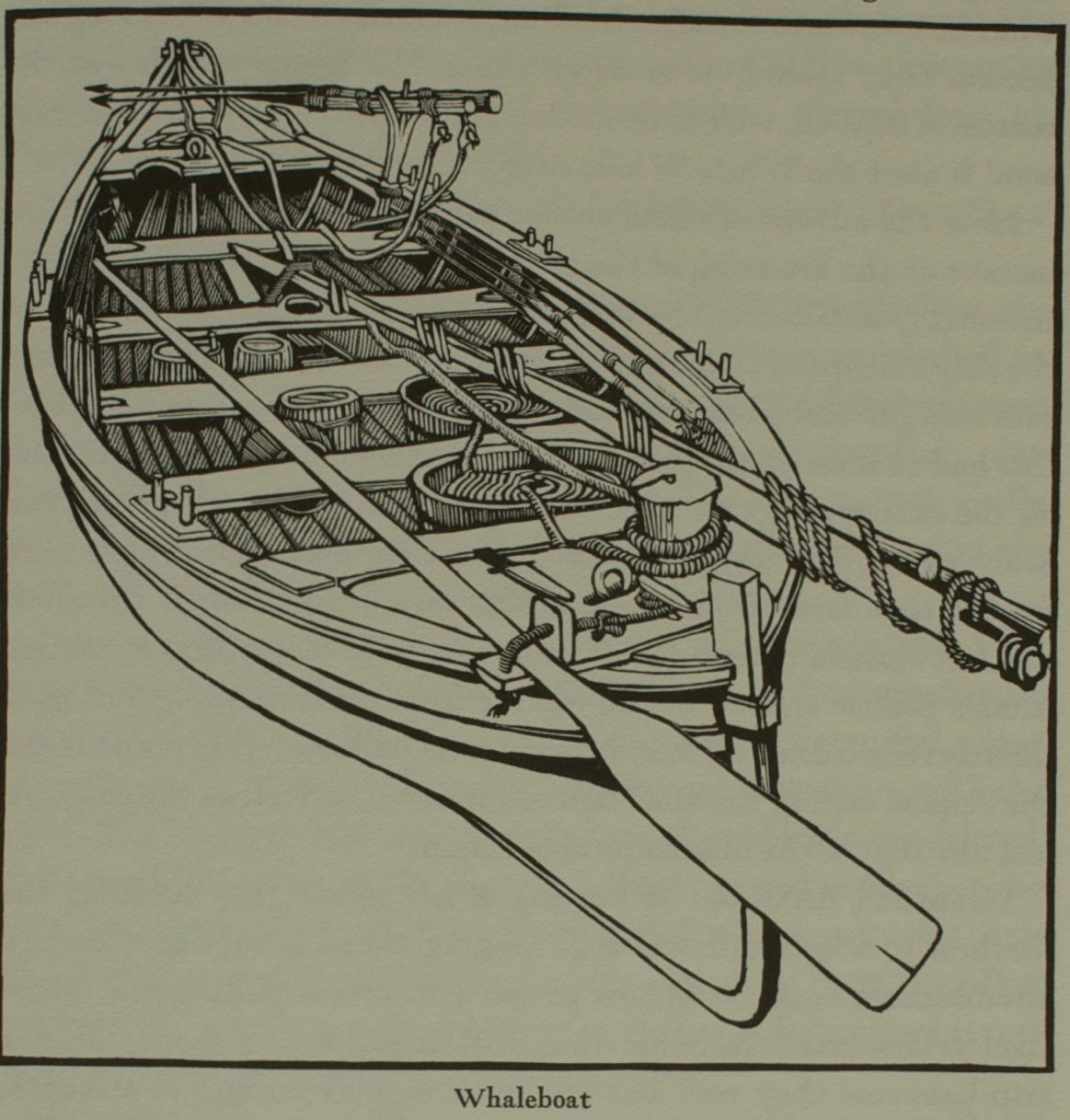
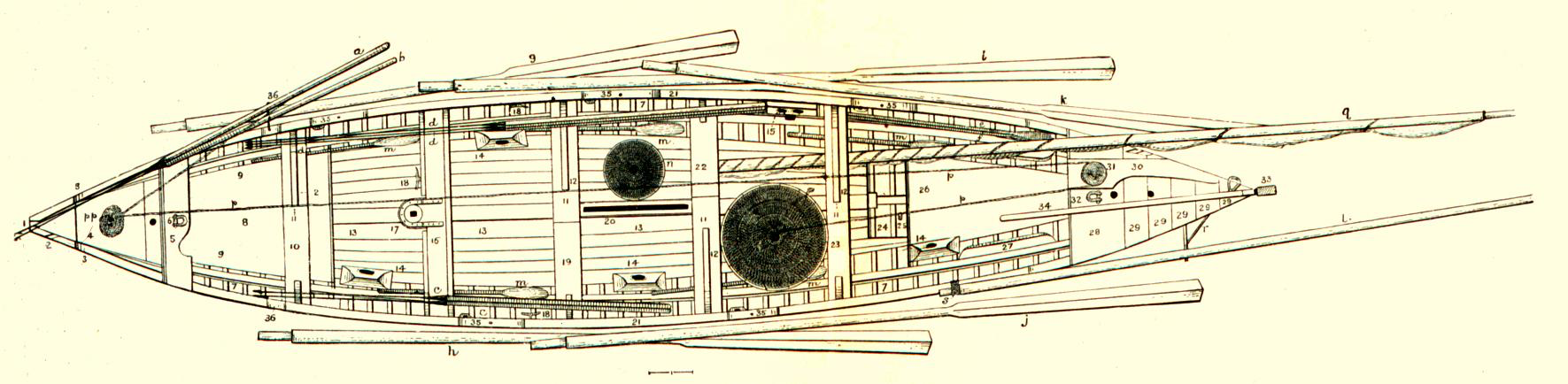
The whale-line is only two-thirds of an inch in thickness. At first sight, you would not think it so strong as it really is. By experiment its one and fifty yarns will each suspend a weight of one hundred and twenty pounds;4 so that the whole rope will bear a strain nearly equal to three tons. In length, the common sperm whale-line measures something over two hundred fathoms.5 Towards the stern of the boat it is spirally coiled away in the tub, not like the worm-pipe of a still6 though, but so as to form one round, cheese-shaped mass7 of densely bedded “sheaves,”8 or layers of concentric spiralizations, without any hollow but the “heart,” or minute vertical tube [BJ says line] formed at the axis of the cheese. As the least tangle or kink in the coiling would, in running out, infallibly take somebody’s arm, leg, or entire body off, the utmost precaution is used in stowing the line in its tub. Some harpooneers will consume almost an entire morning in this business, carrying the line high aloft and then reeving9 it downwards through a block towards the tub, so as in the act of coiling to free it from all possible wrinkles and twists.
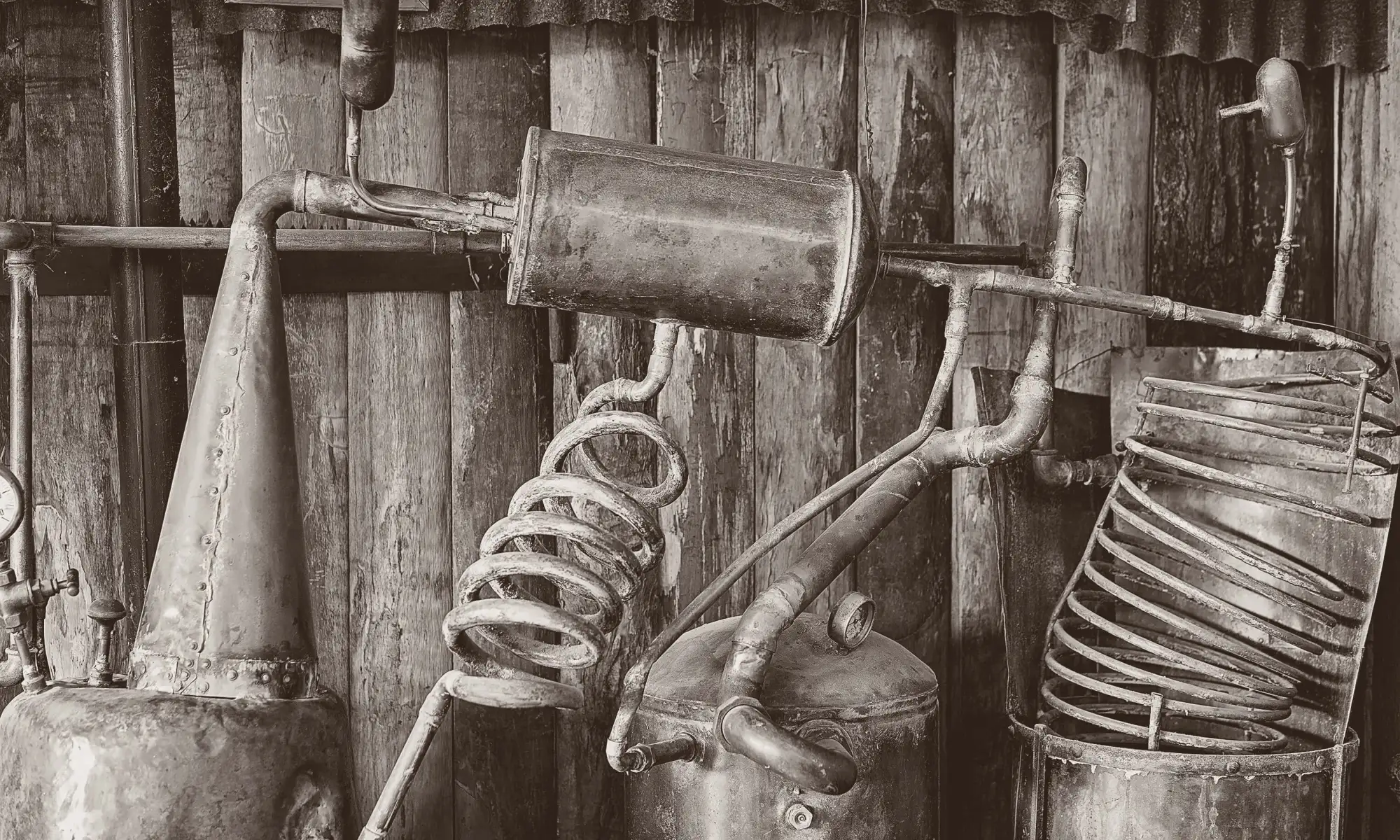
worm pipe
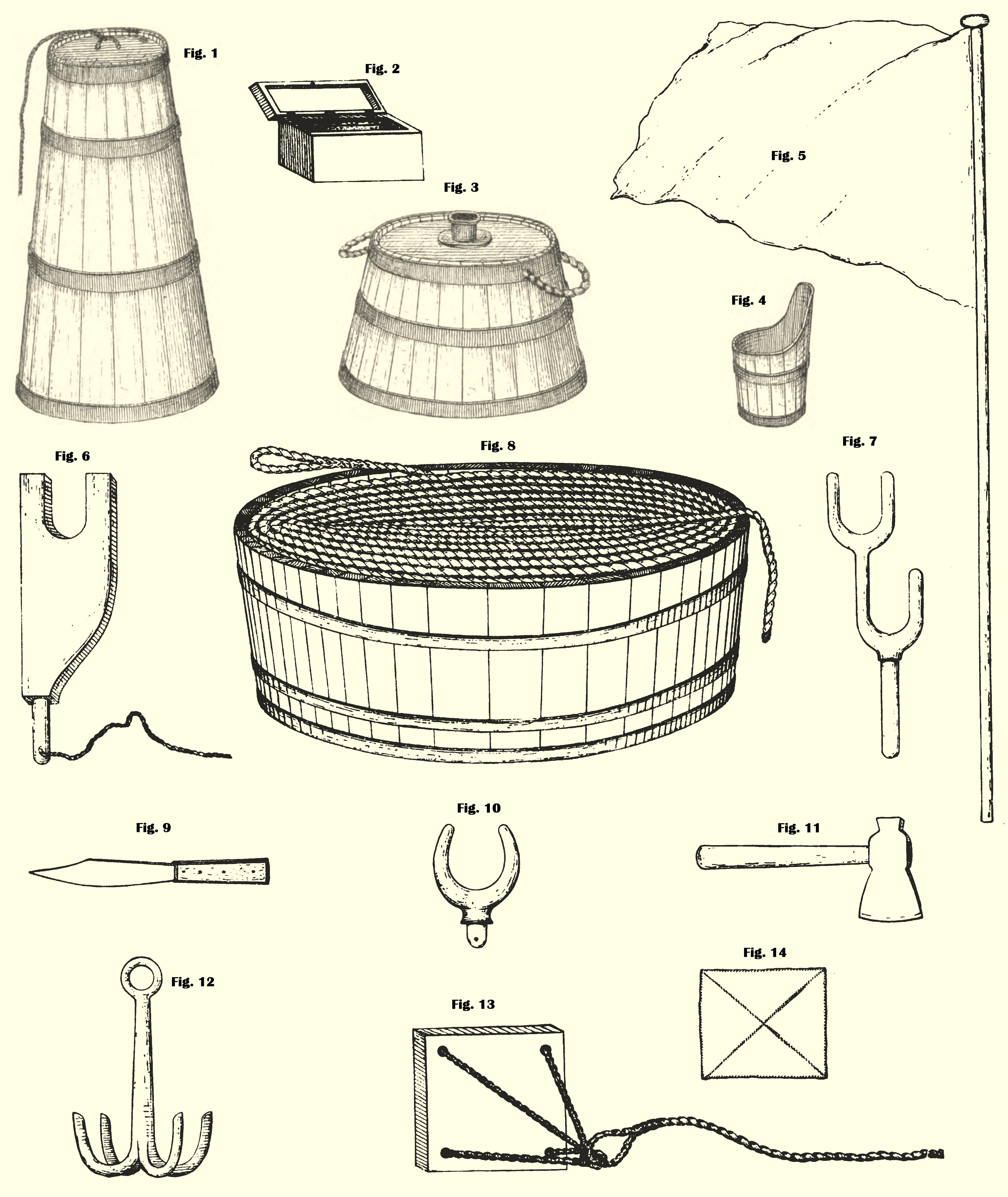
In the English boats two tubs are used instead of one; the same line being continuously coiled in both tubs. There is some advantage in this; because these twin-tubs being so small they fit more readily into the boat, and do not strain it so much; whereas, the American tub, nearly three feet in diameter and of proportionate depth, makes a rather bulky freight for a craft whose planks are but one half-inch in thickness; for the bottom of the whale-boat is like critical ice, which will bear up a considerable distributed weight, but not very much of a concentrated one. When the painted canvas cover is clapped on the American line-tub, the boat looks as if it were pulling off with a prodigious great wedding-cake to present to the whales.
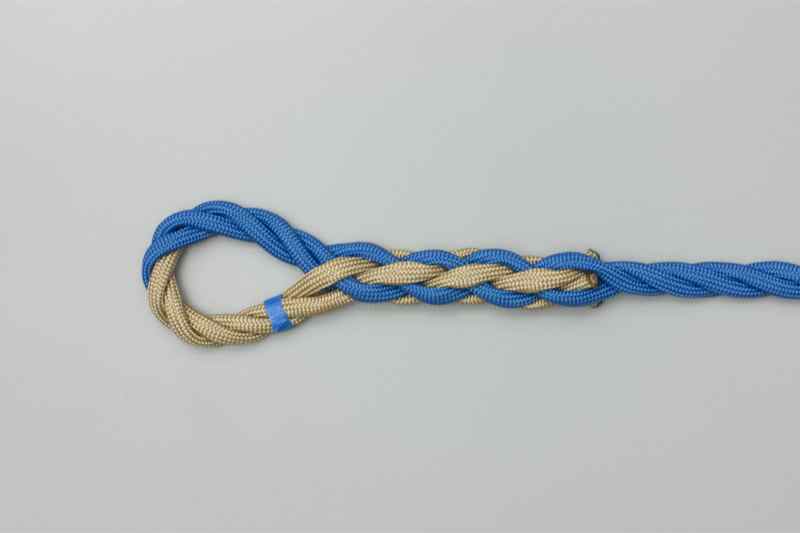 eye splice
Both ends of the line are exposed; the lower end terminating in an eye-splice10 or loop coming up from the bottom against the side of the tub, and hanging over its edge completely disengaged from everything.11 This arrangement of the lower end is necessary on two accounts. First: In order to facilitate the fastening to it of an additional line from a neighboring boat, in case the stricken whale should sound so deep as to threaten to carry off the entire line originally attached to the harpoon. In these instances, the whale of course is shifted like a mug of ale, as it were, from the one boat to the other; though the first boat always hovers at hand to assist its consort. Second: This arrangement is indispensable for common safety’s sake; for were the lower end of the line in any way attached to the boat, and were the whale then to run the line out to the end almost in a single, smoking minute as he sometimes does, he would not stop there, for the doomed boat would infallibly be dragged down after him into the profundity of the sea; and in that case no town-crier would ever find her again.
Before lowering the boat for the chase, the upper end of the line is taken aft from the tub, and passing round the loggerhead12 there, is again carried forward the entire length of the boat, resting crosswise upon the loom or handle of every man’s oar, so that it jogs against his wrist in rowing; and also passing between the men, as they alternately sit at the opposite gunwales, to the leaded chocks13 or grooves in the extreme pointed prow of the boat, where a wooden pin or skewer the size of a common quill, prevents it from slipping out. From the chocks it hangs in a slight festoon14 over the bows, and is then passed inside the boat again; and some ten or twenty fathoms (called box-line15) being coiled upon the box in the bows, it continues its way to the gunwale still a little further aft, and is then attached to the short-warp—the rope which is immediately connected with the harpoon; but previous to that connection, the short-warp goes through sundry mystifications too tedious to detail.16
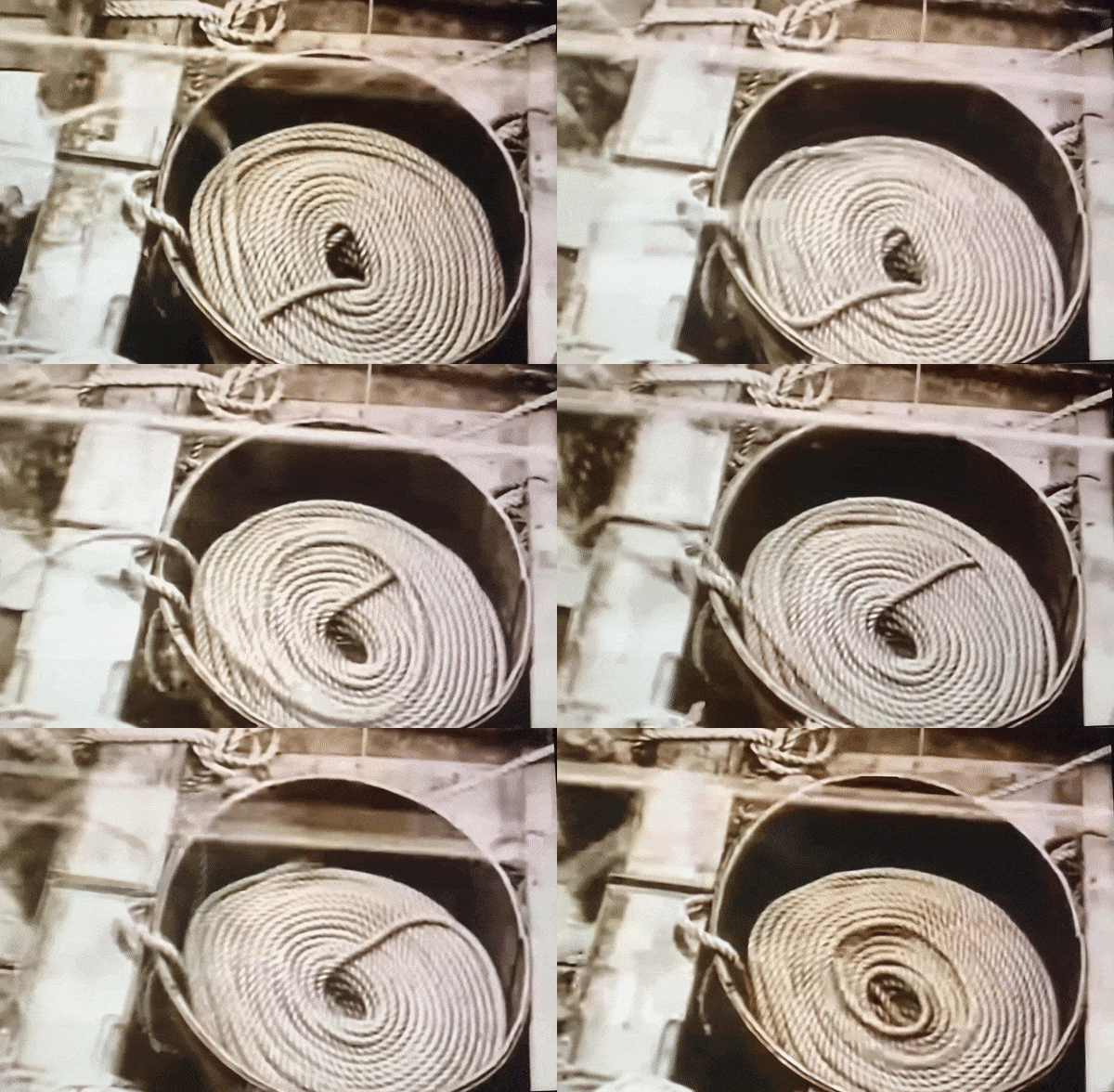 1920s whaling line feeding out
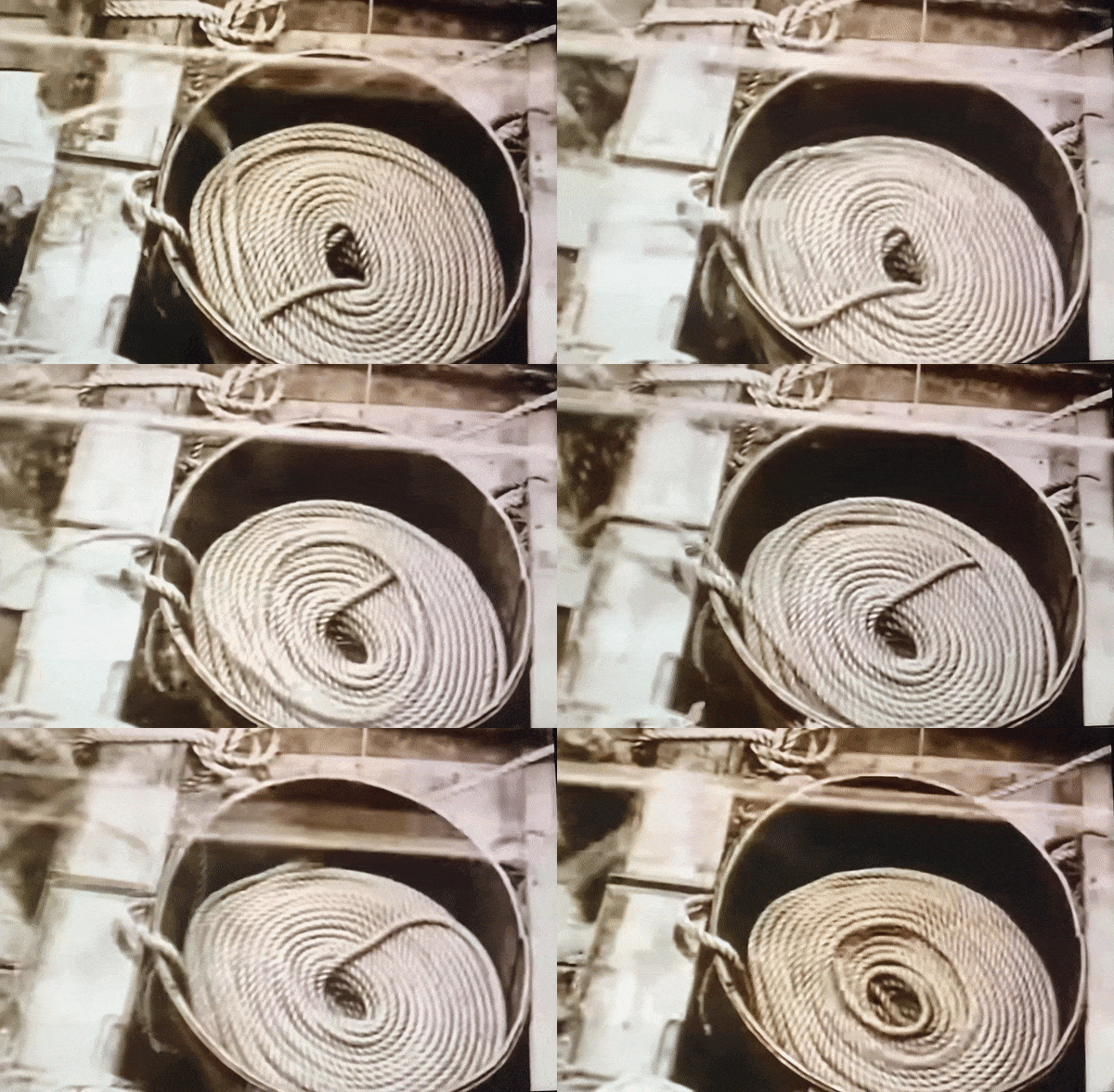 Footage from Down to the Sea In Ships of a fast line paying out while someone splashes water on it off camera. (just like in Jaws!)
Thus the whale-line folds the whole boat in its complicated coils,17 twisting and writhing around it in almost every direction. All the oarsmen are involved in its perilous contortions; so that to the timid eye of the landsman, they seem as Indian jugglers,18 with the deadliest snakes sportively festooning their limbs. Nor can any son of mortal woman, for the first time, seat himself amid those hempen intricacies, and while straining his utmost at the oar, bethink him that at any unknown instant the harpoon may be darted, and all these horrible contortions be put in play like ringed lightnings; he cannot be thus circumstanced without a shudder that makes the very marrow in his bones to quiver in him like a shaken jelly. Yet habit—strange thing! what cannot habit accomplish?—Gayer sallies, more merry mirth, better jokes, and brighter repartees, you never heard over your mahogany,19 than you will hear over the half-inch white cedar of the whale-boat, when thus hung in hangman’s nooses; and, like the six burghers of Calais20 before King Edward, the six men composing the crew pull into the jaws of death, with a halter around every neck, as you may say.
From Substack
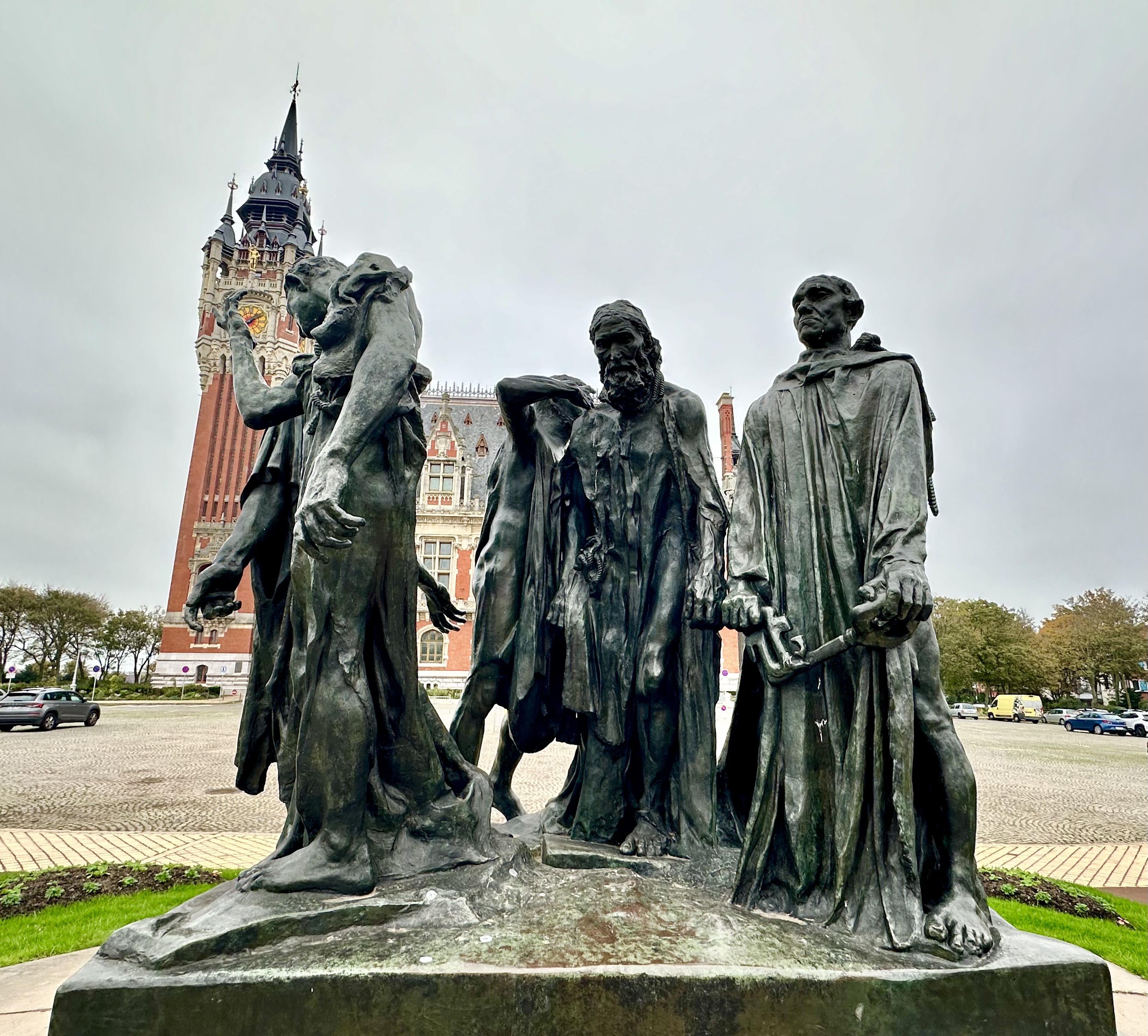
Rodin’s Burghers of Calais
Perhaps a very little thought will now enable you to account for those repeated whaling disasters—some few of which are casually chronicled—of this man or that man being taken out of the boat by the line, and lost. For, when the line is darting out, to be seated then in the boat, is like being seated in the midst of the manifold whizzings of a steam-engine in full play, when every flying beam, and shaft, and wheel, is grazing you.21 It is worse; for you cannot sit motionless in the heart of these perils, because the boat is rocking like a cradle, and you are pitched one way and the other, without the slightest warning; and only by a certain self-adjusting buoyancy and simultaneousness of volition and action, can you escape being made a Mazeppa22 of, and run away with where the all-seeing sun himself could never pierce you out.
Again: as the profound calm which only apparently precedes and prophesies of the storm, is perhaps more awful than the storm itself; for, indeed, the calm is but the wrapper and envelope of the storm; and contains it in itself, as the seemingly harmless rifle holds the fatal powder, and the ball, and the explosion; so the graceful repose of the line, as it silently serpentines about the oarsmen before being brought into actual play—this is a thing which carries more of true terror than any other aspect of this dangerous affair. But why say more? All men live enveloped in whale-lines. All are born with halters round their necks;23 but it is only when caught in the swift, sudden turn of death, that mortals realize the silent, subtle, ever-present perils of life. And if you be a philosopher, though seated in the whale-boat, you would not at heart feel one whit more of terror, than though seated before your evening fire with a poker, and not a harpoon, by your side.
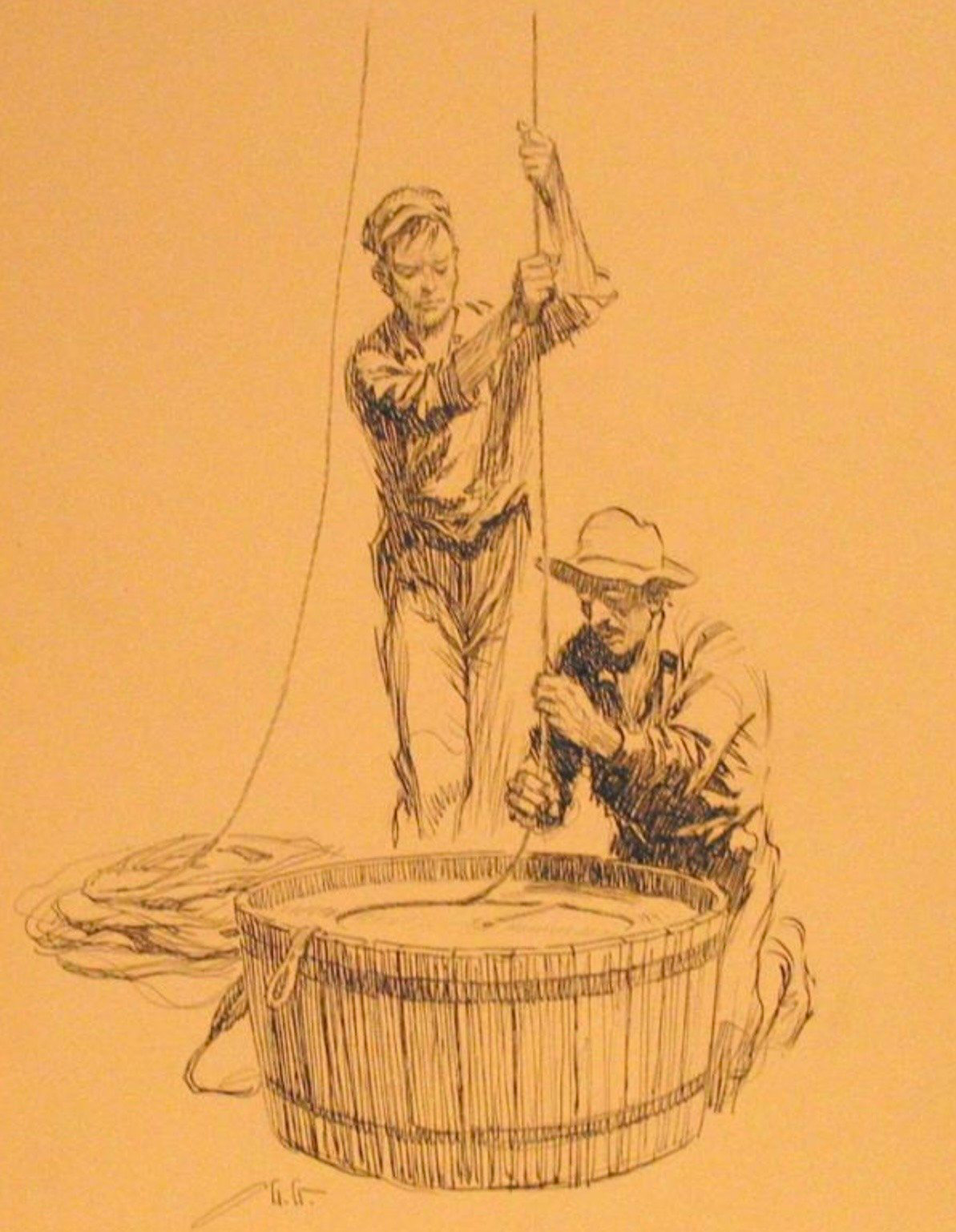 Great details here about why this was all so important, from S.J. Costello
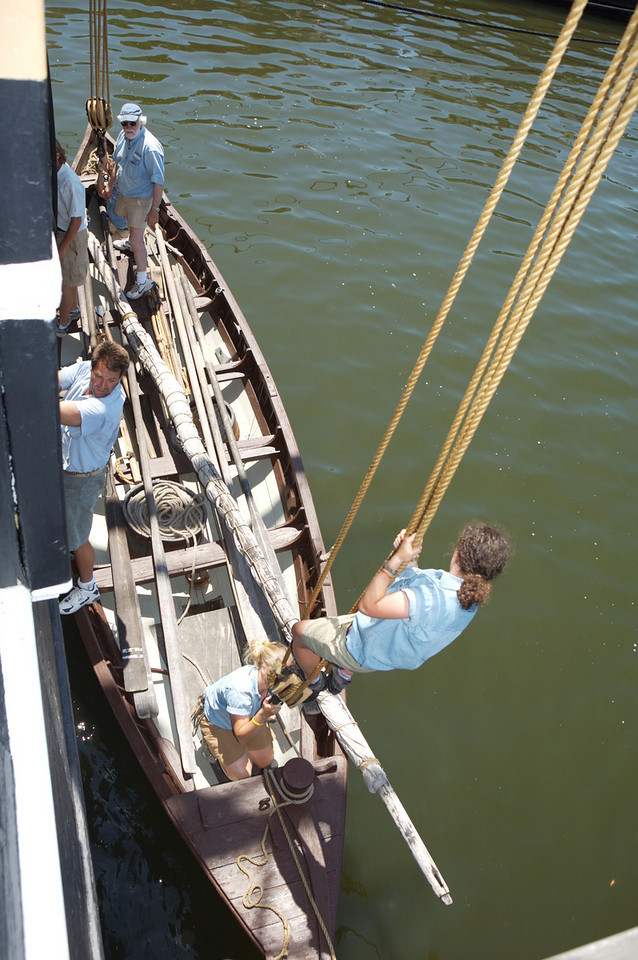
These guys would not make it home with a rope coiled like that!
FOOTNOTES
Footnotes
-
hemp: Rope made from the Cannabis sativa plant, which is native to Asia but naturalized or cultivated in many parts of the world, is made from the stalksof the plant. Hemp was also used for sails and apparently is where the word “canvas” comes from. ↩
-
Manilla rope: Made of abaca fiber (part of the banana family), also called Manila hemp, this kind of rope was first imported from Manila, capital of the Philippines; like bamboo, it is not likely to rot…and good that we switched from Hemp because it’s still illegal to grow in 40 states (I think it’s still only 10 that allow it). ↩
-
hemp … Circassian: Ishmael is saying that whereas hemp suggests the generally dark complexion of the people of India, “Manilla rope” evokes the proverbially blond and beautiful Cherkess people who lived mainly in Russia’s Black Sea region. Also: refers to the Adyghe people of the Caucasus, who are fair-skinned, blond-haired, and blue-eyed. In the film Lawrence of Arabia, T. E. Lawrence tries to conceal his identity and explain his fair appearance by claiming to be Circassian ↩
-
twenty pounds: Melville’s math doesn’t math here because of a transcription error while he compiled notes. It doesn’t make a huge difference, though. The rope can handle 18,000 pounds (nine tons) of strain. ↩
-
two hundred fathoms: 1,200 feet ↩
-
that coiled metal pipe on a still, used for distilling alcohol. ↩
-
cheese-shaped mass: In describing the coiled line, Melville distinguishes it from the coiled condensing unit or “worm” of a distillery, a lengthy coil like a spiral staircase. However, the whale line is coiled in a flattened, round, tightly-layered shape resembling a wheel of cheese, with a tiny shaft of space at its center. ↩
-
sheaves: Melville’s quotation marks around “sheaves”—meaning “layers of a coiled rope”—indicates that the word is an unusual usage, which he probably borrowed from Frederick Debell Bennett’s 1840 Narrative of a Whaling Voyage, one of Melville’s whaling sources. See also “its complicated coils,” below ↩
-
reeving it…through a block: passing it over the wheel of a pulley ↩
-
a loop at the end of a rope. ↩
-
Re: knitting from both ends of a yarn ball - either to double your yarn or to knit inverted-striped socks with variagated yarn. I found this note on Reddit: A lady in my knitting group uses a plastic button and runs each end through a hole on the button. I can’t recall which YouTuber she says she got that from, maybe Roxanne Richardson, but she said it helps them from twisting together when knitting from the two ends of one cake of yarn. That sounded VERY useful to me! ↩
-
loggerhead: As defined in “The First Lowering” (Ch. 48), this stout post rises from the keel at the stern. ↩
-
leaded chocks: A groove in the stem of a whaleboat through which the whaleline leads. It is either bushed with lead or fitted with a bronze roller.. https://whalesite.org/whaling/Ashley%20whaling%20glossary.htm#Page_C ↩
-
Festoon: a curved line that hangs between two points, like a garland or chain; 1670–80; < French feston < Italian festone decoration for a feast, derivative of festa festa ↩
-
A section of harpoon line coiled in the bow of the whaleboat. Defined in Ch. 60. ↩
-
Ummmmmmmm… :D ↩
-
its complicated coils: Many of Melville’s facts in this paragraph come from Bennett. See also “sheaves,” above ↩
-
Indian jugglers: Street magicians in India juggled, performed magic tricks, and charmed snakes. In an 1828 essay in Table Talk, a copy of which Melville owned, William Hazlitt marveled at the skill of one such performer. This kiind of lore was the same sort of thing the Brontë kids were weaned on. ↩
-
mahogany: fine dinner table (Melville’s usage). ↩
-
six burghers of Calais before King Edward: refers to the story of Edward III’s siege of Calais in 1347. When the town was taken, Edward was going to order the inhabitants massacred, but agreed to pardon them if six of the town burghers would come to him barefoot and bare-headed with ropes around their necks. When six did, he ordered them executed, but then pardoned them because of the pleas of his queen. The event was most famously commemorated in a sculpture by Auguste Rodin. ↩
-
The steam engine was patented by James Watt in 1781, and certainly was in widespread use by the time of Moby-Dick. Yet Melville observes that as wonderful as it was, there were much more “primitive” devices that had the same characteristic of a mechanistic speed and danger. ↩
-
Mazeppa: This title character of an 1819 poem by George Gordon, Lord Byron (1788-1824) actually Ivan Mazepa) is punished for an adulterous love affair by being tied naked to a horse which was then set free to run across a large swath of Eastern Europe; loosely based on the life of a Ukrainian kossack by that name. SPOILER: foreshadows death of Ahab. (ahem, NOT MUzeppa from “Gypsy” … Heather) ↩
-
Back to early Ishmael. ↩