
Contents
CHAPTER 82. The Honor and Glory of Whaling. CHAPTER 83. Jonah Historically Regarded. FOOTNOTES
CHAPTER 82. The Honor and Glory of Whaling.
There are some enterprises in which a careful disorderliness is the true method.
The more I dive into this matter of whaling, and push my researches up to the very spring-head of it so much the more am I impressed with its great honorableness and antiquity; and especially when I find so many great demi-gods and heroes, prophets of all sorts, who one way or other have shed distinction upon it, I am transported with the reflection that I myself belong, though but subordinately, to so emblazoned a fraternity.
The gallant Perseus, a son of Jupiter, was the first whaleman; and to the eternal honor of our calling be it said, that the first whale attacked by our brotherhood was not killed with any sordid intent. Those were the knightly days of our profession, when we only bore arms to succor the distressed, and not to fill men’s lamp-feeders. Every one knows the fine story of Perseus and Andromeda;1 how the lovely Andromeda, the daughter of a king, was tied to a rock on the sea-coast, and as Leviathan was in the very act of carrying her off, Perseus, the prince of whalemen, intrepidly advancing, harpooned the monster, and delivered and married the maid. It was an admirable artistic exploit, rarely achieved by the best harpooneers of the present day; inasmuch as this Leviathan was slain at the very first dart. And let no man doubt this Arkite2 story; for in the ancient Joppa, now Jaffa,3 on the Syrian coast, in one of the Pagan temples, there stood for many ages the vast skeleton of a whale, which the city’s legends and all the inhabitants asserted to be the identical bones of the monster that Perseus slew. When the Romans took Joppa,4 the same skeleton was carried to Italy in triumph. What seems most singular and suggestively important in this story, is this: it was from Joppa that Jonah set sail.5
Akin to the adventure of Perseus and Andromeda—indeed, by some supposed to be indirectly derived from it—is that famous story of St. George and the Dragon;6 which dragon I maintain to have been a whale; for in many old chronicles whales and dragons are strangely jumbled together, and often stand for each other. “Thou art as a lion of the waters,7 and as a dragon of the sea,”8 saith Ezekiel; hereby, plainly meaning a whale; in truth, some versions of the Bible use that word itself. Besides, it would much subtract from the glory of the exploit had St. George but encountered a crawling reptile of the land, instead of doing battle with the great monster of the deep. Any man may kill a snake, but only a Perseus, a St. George, a Coffin,9 have the heart in them to march boldly up to a whale.
Let not the modern paintings of this scene mislead us; for though the creature encountered by that valiant whaleman of old is vaguely represented of a griffin-like shape,10 and though the battle is depicted on land and the saint on horseback, yet considering the great ignorance of those times, when the true form of the whale was unknown to artists; and considering that as in Perseus’ case, St. George’s whale might have crawled up out of the sea on the beach; and considering that the animal ridden by St. George might have been only a large seal, or sea-horse; bearing all this in mind, it will not appear altogether incompatible with the sacred legend and the ancientest draughts of the scene, to hold this so-called dragon no other than the great Leviathan himself. In fact, placed before the strict and piercing truth, this whole story will fare like that fish, flesh, and fowl idol of the Philistines, Dagon11 by name; who being planted before the ark of Israel, his horse’s head and both the palms of his hands fell off from him, and only the stump or fishy part of him remained.12 Thus, then, one of our own noble stamp, even a whaleman, is the tutelary guardian of England;13 and by good rights, we harpooneers of Nantucket should be enrolled in the most noble order of St. George.14 And therefore, let not the knights of that honorable company (none of whom, I venture to say, have ever had to do with a whale like their great patron), let them never eye a Nantucketer with disdain, since even in our woollen frocks and tarred trowsers we are much better entitled to St. George’s decoration than they.
Whether to admit Hercules among us or not, concerning this I long remained dubious: for though according to the Greek mythologies, that antique Crockett15 and Kit Carson16—that brawny doer of rejoicing good deeds, was swallowed down and thrown up by a whale; still, whether that strictly makes a whaleman of him, that might be mooted.17 It nowhere appears that he ever actually harpooned his fish, unless, indeed, from the inside. Nevertheless, he may be deemed a sort of involuntary whaleman; at any rate the whale caught him, if he did not the whale. I claim him for one of our clan.
But, by the best contradictory authorities, this Grecian story of Hercules and the whale is considered to be derived from the still more ancient Hebrew story of Jonah and the whale; and vice versâ; certainly they are very similar. If I claim the demi-god then, why not the prophet?
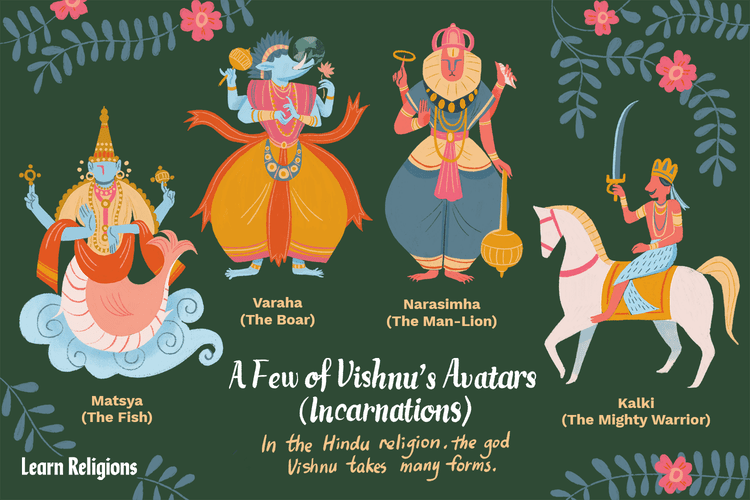
Nor do heroes, saints, demigods, and prophets alone comprise the whole roll of our order. Our grand master18 is still to be named; for like royal kings of old times, we find the head waters of our fraternity in nothing short of the great gods themselves. That wondrous oriental story is now to be rehearsed from the Shaster,19 which gives us the dread Vishnoo,20 one of the three persons in the godhead of the Hindoos; gives us this divine Vishnoo himself for our Lord;—Vishnoo, who, by the first of his ten earthly incarnations, has for ever set apart and sanctified the whale. When Brahma, or the God of Gods, saith the Shaster, resolved to recreate the world after one of its periodical dissolutions, he gave birth to Vishnoo, to preside over the work; but the Vedas, or mystical books, whose perusal would seem to have been indispensable to Vishnoo before beginning the creation, and which therefore must have contained something in the shape of practical hints to young architects, these Vedas21 were lying at the bottom of the waters; so Vishnoo became incarnate in a whale, and sounding down in him to the uttermost depths, rescued the sacred volumes. Was not this Vishnoo a whaleman, then? even as a man who rides a horse is called a horseman?
Perseus, St. George, Hercules, Jonah, and Vishnoo! there’s a member-roll for you! What club but the whaleman’s can head off like that?
CHAPTER 83. Jonah Historically Regarded.
Reference was made to the historical story of Jonah and the whale in the preceding chapter. Now some Nantucketers rather distrust this historical story of Jonah and the whale. But then there were some sceptical Greeks and Romans, who, standing out from the orthodox pagans of their times, equally doubted the story of Hercules and the whale, and Arion and the dolphin;22 and yet their doubting those traditions did not make those traditions one whit the less facts, for all that.
One old Sag-Harbor whaleman’s chief reason for questioning the Hebrew story was this:—He had one of those quaint old-fashioned Bibles, embellished with curious, unscientific plates; one of which represented Jonah’s whale with two spouts in his head—a peculiarity only true with respect to a species of the Leviathan (the Right Whale, and the varieties of that order), concerning which the fishermen have this saying, “A penny roll would choke him”; his swallow is so very small. But, to this, Bishop Jebb’s23 anticipative answer is ready. It is not necessary, hints the Bishop, that we consider Jonah as tombed in the whale’s belly, but as temporarily lodged in some part of his mouth. And this seems reasonable enough in the good Bishop. For truly, the Right Whale’s mouth would accommodate a couple of whist-tables, and comfortably seat all the players. Possibly, too, Jonah might have ensconced himself in a hollow tooth; but, on second thoughts, the Right Whale is toothless.
Another reason which Sag-Harbor (he went by that name) urged for his want of faith in this matter of the prophet, was something obscurely in reference to his incarcerated body and the whale’s gastric juices. But this objection likewise falls to the ground, because a German exegetist supposes that Jonah must have taken refuge in the floating body of a dead whale—even as the French soldiers in the Russian campaign turned their dead horses into tents, and crawled into them. Besides, it has been divined by other continental commentators, that when Jonah was thrown overboard from the Joppa ship, he straightway effected his escape to another vessel near by, some vessel with a whale for a figure-head; and, I would add, possibly called “The Whale,” as some craft are nowadays christened the “Shark,” the “Gull,” the “Eagle.” Nor have there been wanting learned exegetists who have opined that the whale mentioned in the book of Jonah merely meant a life-preserver—an inflated bag of wind—which the endangered prophet swam to, and so was saved from a watery doom. Poor Sag-Harbor, therefore, seems worsted all round. But he had still another reason for his want of faith. It was this, if I remember right: Jonah was swallowed by the whale in the Mediterranean Sea, and after three days he was vomited up somewhere within three days’ journey of Nineveh, a city on the Tigris, very much more than three days’ journey across from the nearest point of the Mediterranean coast. How is that?
But was there no other way for the whale to land the prophet within that short distance of Nineveh? Yes. He might have carried him round by the way of the Cape of Good Hope. But not to speak of the passage through the whole length of the Mediterranean, and another passage up the Persian Gulf and Red Sea, such a supposition would involve the complete circumnavigation of all Africa in three days, not to speak of the Tigris waters, near the site of Nineveh, being too shallow for any whale to swim in. Besides, this idea of Jonah’s weathering the Cape of Good Hope at so early a day would wrest the honor of the discovery of that great headland from Bartholomew Diaz, its reputed discoverer, and so make modern history a liar.
But all these foolish arguments of old Sag-Harbor only evinced his foolish pride of reason—a thing still more reprehensible in him, seeing that he had but little learning except what he had picked up from the sun and the sea. I say it only shows his foolish, impious pride, and abominable, devilish rebellion against the reverend clergy. For by a Portuguese Catholic priest, this very idea of Jonah’s going to Nineveh via the Cape of Good Hope was advanced as a signal magnification of the general miracle. And so it was. Besides, to this day, the highly enlightened Turks devoutly believe in the historical story of Jonah. And some three centuries ago, an English traveller in old Harris’s Voyages, speaks of a Turkish Mosque built in honor of Jonah, in which Mosque was a miraculous lamp that burnt without any oil.
Footnotes
Footnotes
-
Andromeda: Perseus’s wife, whom he won by saving from a sea monster ↩
-
Arkite: from Arqa, an ancient city in what is now northern Lebanon ↩
-
Jaffa: a port city that belonged to Syria when Moby-Dick was written, but which is now part of Israel ↩
-
When the Romans took Joppa: a politician named Marcus Aemilius Scaurus (first century B.C.) brought “sea serpent” bones from Joppa to Rome in 58 B.C. ↩
-
It was from Joppa that Jonah set sail: God ordered the prophet Jonahto travel to Nineveh to preach. Instead, he sought passage on a ship out of Joppa ↩
-
St. George and the Dragon:the Christian St. George (ca 275-303), a Roman soldier, was said to have saved a young girl from being sacrificed to a dragon by killing the beast ↩
-
“Thou art as a lion…”: the 1587 Geneva Bible translation of Ezekiel 32:2reads “Thou art like a lyon of the nations and art as a dragon in the sea” ↩
-
Ezekiel 32.2 ↩
-
Coffin: a member of the famous Coffin family of whalers in Nantucket ↩
-
Griffin-like: like a gryphon, a mythological creature with the body of a lion and the head and wings of an eagle ↩
-
Dagon: a fish-god revered by ancient inhabitants of modern-day Israel ↩
-
this story is told in I Samuel 5 ↩
-
Tutelary: serving as a protector; Guardian of England: St. George is England’s patron saint ↩
-
Order of St. George: the Order of the Garter, a chivalric order dedicated to St. George ↩
-
Crockett: Davy Crockett(1786-1836), a hero of the American frontier ↩
-
Kit Carson: (1809-1868), a hero of the American frontier ↩
-
Mooted: debated ↩
-
Grand master: a rank in Freemasonry, a fraternal organization ↩
-
Shaster (Shastra): sacred texts containing the laws of the Hindu religion, while in Buddhism and Jainism a Shastra is commentary written to explain earlier scriptures and sutras. A Shastra is also a class of weapons particular to Sikh history. Sacred symbols of righteous struggle against oppression. ↩
-
Hercules and the whale: the second labor of Hercules was to kill the Hydra, a sea monster; Arion: a poet in ancient Greece who was said to have been kidnapped by pirates and rescued by dolphins ↩
-
Bishop Jebb: John Jebb (1775-1833), an Irish churchman and author of the influential Bible commentary Sacred Literature ↩