Contents
CHAPTER 106. Ahab’s Leg.
The precipitating manner in which Captain Ahab had quit the Samuel Enderby of London, had not been unattended with some small violence to his own person. He had lighted with such energy upon a thwart of his boat that his ivory leg had received a half-splintering shock. And when after gaining his own deck, and his own pivot-hole there,1 he so vehemently wheeled round with an urgent command to the steersman (it was, as ever, something about his not steering inflexibly enough); then, the already shaken ivory received such an additional twist and wrench, that though it still remained entire, and to all appearances lusty, yet Ahab did not deem it entirely trustworthy.
And, indeed, it seemed small matter for wonder, that for all his pervading, mad recklessness, Ahab did at times give careful heed to the condition of that dead bone upon which he partly stood. For it had not been very long prior to the Pequod’s sailing from Nantucket, that he had been found one night lying prone upon the ground, and insensible; by some unknown, and seemingly inexplicable, unimaginable casualty, his ivory limb having been so violently displaced, that it had stake-wise smitten, and all but pierced his groin;2 nor was it without extreme difficulty that the agonizing wound was entirely cured.
Nor, at the time, had it failed to enter his monomaniac mind, that all the anguish of that then present suffering was but the direct issue of a former woe; and he too plainly seemed to see, that as the most poisonous reptile of the marsh perpetuates his kind as inevitably as the sweetest songster of the grove; so, equally with every felicity, all miserable events do naturally beget their like.3 Yea, more than equally, thought Ahab; since both the ancestry and posterity of Grief go further than the ancestry and posterity of Joy. For, not to hint of this: that it is an inference from certain canonic teachings,4 that while some natural enjoyments here shall have no children born to them for the other world, but, on the contrary, shall be followed by the joy-childlessness of all hell’s despair; whereas, some guilty mortal miseries shall still fertilely beget to themselves an eternally progressive progeny of griefs beyond the grave; not at all to hint of this, there still seems an inequality in the deeper analysis of the thing. For, thought Ahab, while even the highest earthly felicities ever have a certain unsignifying pettiness lurking in them, but, at bottom, all heartwoes, a mystic significance, and, in some men, an archangelic grandeur; so do their diligent tracings-out not belie the obvious deduction. To trail the genealogies of these high mortal miseries, carries us at last among the sourceless primogenitures of the gods;5 so that, in the face of all the glad, hay-making suns, and soft cymballing, round harvest-moons, we must needs give in to this: that the gods themselves are not for ever glad.6 The ineffaceable, sad birth-mark in the brow of man, is but the stamp of sorrow in the signers.7
Unwittingly here a secret has been divulged, which perhaps might more properly, in set way, have been disclosed before. With many other particulars concerning Ahab, always had it remained a mystery to some, why it was, that for a certain period, both before and after the sailing of the Pequod, he had hidden himself away with such Grand-Lama-like exclusiveness;8 and, for that one interval, sought speechless refuge, as it were, among the marble senate of the dead. Captain Peleg’s bruited reason for this thing9 appeared by no means adequate; though, indeed, as touching all Ahab’s deeper part, every revelation partook more of significant darkness than of explanatory light. But, in the end, it all came out; this one matter did, at least. That direful mishap was at the bottom of his temporary recluseness. And not only this, but to that ever-contracting, dropping circle ashore, who, for any reason, possessed the privilege of a less banned approach to him; to that timid circle the above hinted casualty—remaining, as it did, moodily unaccounted for by Ahab—invested itself with terrors, not entirely underived from the land of spirits and of wails. So that, through their zeal for him, they had all conspired, so far as in them lay, to muffle up the knowledge of this thing from others; and hence it was, that not till a considerable interval had elapsed, did it transpire upon the Pequod’s decks.
But be all this as it may; let the unseen, ambiguous synod in the air, or the vindictive princes and potentates of fire,10 have to do or not with earthly Ahab, yet, in this present matter of his leg, he took plain practical procedures;—he called the carpenter.
And when that functionary appeared before him, he bade him without delay set about making a new leg, and directed the mates to see him supplied with all the studs and joists of jaw-ivory (Sperm Whale)11 which had thus far been accumulated on the voyage, in order that a careful selection of the stoutest, clearest-grained stuff might be secured. This done, the carpenter received orders to have the leg completed that night; and to provide all the fittings for it, independent of those pertaining to the distrusted one in use. Moreover, the ship’s forge was ordered to be hoisted out of its temporary idleness in the hold;12 and, to accelerate the affair, the blacksmith was commanded to proceed at once to the forging of whatever iron contrivances might be needed.
CHAPTER 107. The Carpenter.
Seat thyself sultanically among the moons of Saturn,13 and take high abstracted man alone; and he seems a wonder, a grandeur, and a woe. But from the same point, take mankind in mass, and for the most part, they seem a mob of unnecessary duplicates,14 both contemporary and hereditary. But most humble though he was, and far from furnishing an example of the high, humane abstraction; the Pequod’s carpenter was no duplicate; hence, he now comes in person on this stage.15
Like all sea-going ship carpenters, and more especially those belonging to whaling vessels, he was, to a certain off-handed, practical extent, alike experienced in numerous trades and callings collateral to his own; the carpenter’s pursuit being the ancient and outbranching trunk of all those numerous handicrafts which more or less have to do with wood as an auxiliary material. But, besides the application to him of the generic remark above, this carpenter of the Pequod was singularly efficient in those thousand nameless mechanical emergencies continually recurring in a large ship, upon a three or four years’ voyage, in uncivilized and far-distant seas. For not to speak of his readiness in ordinary duties:—repairing stove boats, sprung spars, reforming the shape of clumsy-bladed oars, inserting bull’s eyes in the deck, or new tree-nails in the side planks,16 and other miscellaneous matters more directly pertaining to his special business; he was moreover unhesitatingly expert in all manner of conflicting aptitudes, both useful and capricious.
The one grand stage where he enacted all his various parts so manifold, was his vice-bench; a long rude ponderous table furnished with several vices, of different sizes, and both of iron and of wood. At all times except when whales were alongside, this bench was securely lashed athwartships against the rear of the Try-works.17
A belaying pin is found too large18 to be easily inserted into its hole: the carpenter claps it into one of his ever-ready vices, and straightway files it smaller. A lost land-bird of strange plumage strays on board, and is made a captive: out of clean shaved rods of right-whale bone, and cross-beams of sperm whale ivory, the carpenter makes a pagoda-looking cage for it.19 An oarsman sprains his wrist: the carpenter concocts a soothing lotion. Stubb longed for vermilion stars to be painted upon the blade of his every oar;20 screwing each oar in his big vice of wood, the carpenter symmetrically supplies the constellation. A sailor takes a fancy to wear shark-bone ear-rings: the carpenter drills his ears.21 Another has the toothache: the carpenter out pincers, and clapping one hand upon his bench bids him be seated there; but the poor fellow unmanageably winces under the unconcluded operation; whirling round the handle of his wooden vice, the carpenter signs him to clap his jaw in that, if he would have him draw the tooth.22
Thus, this carpenter was prepared at all points, and alike indifferent and without respect in all. Teeth he accounted bits of ivory; heads he deemed but top-blocks; men themselves he lightly held for capstans.23 But while now upon so wide a field thus variously accomplished and with such liveliness of expertness in him, too; all this would seem to argue some uncommon vivacity of intelligence. But not precisely so. For nothing was this man more remarkable, than for a certain impersonal stolidity as it were; impersonal, I say; for it so shaded off into the surrounding infinite of things, that it seemed one with the general stolidity discernible in the whole visible world; which while pauselessly active in uncounted modes, still eternally holds its peace, and ignores you, though you dig foundations for cathedrals.24 Yet was this half-horrible stolidity in him, involving, too, as it appeared, an all-ramifying heartlessness;—yet was it oddly dashed at times, with an old, crutch-like, antediluvian, wheezing humorousness, not unstreaked now and then with a certain grizzled wittiness; such as might have served to pass the time during the midnight watch on the bearded forecastle of Noah’s ark.25 Was it that this old carpenter had been a life-long wanderer, whose much rolling, to and fro, not only had gathered no moss;26 but what is more, had rubbed off whatever small outward clingings might have originally pertained to him? He was a stripped abstract; an unfractioned integral;27 uncompromised as a new-born babe; living without premeditated reference to this world or the next. You might almost say, that this strange uncompromisedness in him involved a sort of unintelligence; for in his numerous trades, he did not seem to work so much by reason or by instinct, or simply because he had been tutored to it, or by any intermixture of all these, even or uneven; but merely by a kind of deaf and dumb, spontaneous literal process. He was a pure manipulator; his brain, if he had ever had one, must have early oozed along into the muscles of his fingers. He was like one of those unreasoning but still highly useful, multum in parvo, Sheffield contrivances,28 assuming the exterior—though a little swelled—of a common pocket knife; but containing, not only blades of various sizes, but also screw-drivers, cork-screws, tweezers, awls, pens, rulers, nail-filers, countersinkers. So, if his superiors wanted to use the carpenter for a screw-driver, all they had to do was to open that part of him, and the screw was fast: or if for tweezers, take him up by the legs, and there they were.
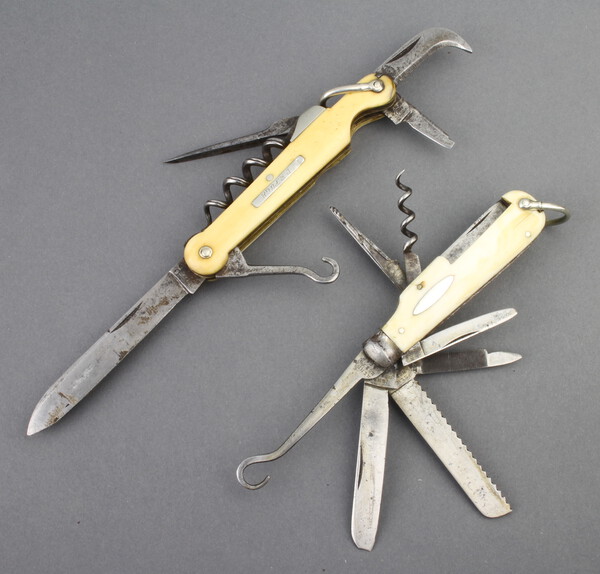
Yet, as previously hinted, this omnitooled, open-and-shut carpenter, was, after all, no mere machine of an automaton.29 If he did not have a common soul in him, he had a subtle something that somehow anomalously did its duty. What that was, whether essence of quicksilver, or a few drops of hartshorn,30 there is no telling. But there it was; and there it had abided for now some sixty years or more. And this it was, this same unaccountable, cunning life-principle in him; this it was, that kept him a great part of the time soliloquizing; but only like an unreasoning wheel, which also hummingly soliloquizes; or rather, his body was a sentry-box and this soliloquizer on guard there, and talking all the time to keep himself awake.31
CHAPTER 108. Ahab and the Carpenter.
The Deck—First Night Watch.
(Carpenter standing before his vice-bench,32 and by the light of two lanterns busily filing the ivory joist for the leg, which joist is firmly fixed in the vice. Slabs of ivory, leather straps, pads, screws, and various tools of all sorts lying about the bench. Forward, the red flame of the forge is seen, where the blacksmith is at work.)
Drat the file, and drat the bone! That is hard which should be soft, and that is soft which should be hard.33 So we go, who file old jaws and shinbones. Let’s try another. Aye, now, this works better (sneezes). Halloa, this bone dust is (sneezes)—why it’s (sneezes)—yes it’s (sneezes)—bless my soul, it won’t let me speak! This is what an old fellow gets now for working in dead lumber. Saw a live tree, and you don’t get this dust; amputate a live bone, and you don’t get it (sneezes). Come, come, you old Smut, there,34 bear a hand, and let’s have that ferule and buckle-screw;35 I’ll be ready for them presently. Lucky now (sneezes) there’s no knee-joint to make; that might puzzle a little; but a mere shinbone—why it’s easy as making hop-poles;36 only I should like to put a good finish on. Time, time; if I but only had the time, I could turn him out as neat a leg now as ever (sneezes) scraped to a lady in a parlor.37 Those buckskin legs and calves of legs I’ve seen in shop windows wouldn’t compare at all.38 They soak water, they do; and of course get rheumatic, and have to be doctored (sneezes) with washes and lotions, just like live legs. There; before I saw it off, now, I must call his old Mogulship,39 and see whether the length will be all right; too short, if anything, I guess. Ha! that’s the heel; we are in luck; here he comes, or it’s somebody else, that’s certain.
AHAB (advancing)
(During the ensuing scene, the carpenter continues sneezing at times)
Well, manmaker!40
Just in time, sir. If the captain pleases, I will now mark the length. Let me measure, sir.
Measured for a leg! good. Well, it’s not the first time. About it! There; keep thy finger on it. This is a cogent vice thou hast here, carpenter; let me feel its grip once. So, so; it does pinch some.
Oh, sir, it will break bones—beware, beware!
No fear; I like a good grip; I like to feel something in this slippery world that can hold, man.41 What’s Prometheus about there?42—the blacksmith, I mean—what’s he about?
He must be forging the buckle-screw, sir, now.
Right. It’s a partnership; he supplies the muscle part. He makes a fierce red flame there!
Aye, sir; he must have the white heat for this kind of fine work.
Um-m. So he must. I do deem it now a most meaning thing, that that old Greek, Prometheus, who made men, they say, should have been a blacksmith, and animated them with fire; for what’s made in fire must properly belong to fire; and so hell’s probable.43 How the soot flies! This must be the remainder the Greek made the Africans of.44 Carpenter, when he’s through with that buckle, tell him to forge a pair of steel shoulder-blades; there’s a pedlar aboard with a crushing pack.45
Sir?
Hold; while Prometheus is about it, I’ll order a complete man after a desirable pattern.46 Imprimis, fifty feet high in his socks; then, chest modelled after the Thames Tunnel;47 then, legs with roots to ‘em, to stay in one place; then, arms three feet through the wrist; no heart at all, brass forehead,48 and about a quarter of an acre of fine brains; and let me see—shall I order eyes to see outwards? No, but put a sky-light on top of his head to illuminate inwards.49 There, take the order, and away.
Now, what’s he speaking about, and who’s he speaking to, I should like to know? Shall I keep standing here? (aside).
‘Tis but indifferent architecture to make a blind dome; here’s one. No, no, no; I must have a lantern.50
Ho, ho! That’s it, hey? Here are two, sir; one will serve my turn.
What art thou thrusting that thief-catcher into my face for, man?51 Thrusted light is worse than presented pistols.
I thought, sir, that you spoke to carpenter.
Carpenter? why that’s—but no;52—a very tidy, and, I may say, an extremely gentlemanlike sort of business thou art in here, carpenter;—or would’st thou rather work in clay?
Sir?—Clay? clay, sir? That’s mud; we leave clay to ditchers, sir.53
The fellow’s impious! What art thou sneezing about?
Bone is rather dusty, sir.
Take the hint, then; and when thou art dead, never bury thyself under living people’s noses.54
Sir?—oh! ah!—I guess so;—yes—dear!
Look ye, carpenter, I dare say thou callest thyself a right good workmanlike workman, eh? Well, then, will it speak thoroughly well for thy work, if, when I come to mount this leg thou makest, I shall nevertheless feel another leg in the same identical place with it; that is, carpenter, my old lost leg; the flesh and blood one, I mean. Canst thou not drive that old Adam away?55
Truly, sir, I begin to understand somewhat now. Yes, I have heard something curious on that score, sir; how that a dismasted man never entirely loses the feeling of his old spar,56 but it will be still pricking him at times. May I humbly ask if it be really so, sir?
It is, man. Look, put thy live leg here in the place where mine once was; so, now, here is only one distinct leg to the eye, yet two to the soul.57 Where thou feelest tingling life; there, exactly there, there to a hair, do I. Is’t a riddle?
I should humbly call it a poser, sir.
Hist, then. How dost thou know that some entire, living, thinking thing may not be invisibly and uninterpenetratingly standing precisely where thou now standest; aye, and standing there in thy spite? In thy most solitary hours, then, dost thou not fear eavesdroppers? Hold, don’t speak! And if I still feel the smart of my crushed leg, though it be now so long dissolved; then, why mayst not thou, carpenter, feel the fiery pains of hell for ever, and without a body?58 Hah!
Good Lord! Truly, sir, if it comes to that, I must calculate over again; I think I didn’t carry a small figure, sir.59
Look ye, pudding-heads should never grant premises.60—How long before the leg is done?
Perhaps an hour, sir.
Bungle away at it then, and bring it to me (turns to go). Oh, Life! Here I am, proud as Greek god, and yet standing debtor to this blockhead for a bone to stand on! Cursed be that mortal inter-indebtedness which will not do away with ledgers.61 I would be free as air; and I’m down in the whole world’s books. I am so rich, I could have given bid for bid with the wealthiest Praetorians at the auction of the Roman empire62 (which was the world’s); and yet I owe for the flesh in the tongue I brag with. By heavens! I’ll get a crucible, and into it, and dissolve myself down to one small, compendious vertebra.63 So.
CARPENTER (resuming his work).
Well, well, well! Stubb knows him best of all, and Stubb always says he’s queer; says nothing but that one sufficient little word queer; he’s queer, says Stubb;64 he’s queer—queer, queer; and keeps dinning it into Mr. Starbuck all the time—queer—sir—queer, queer, very queer. And here’s his leg! Yes, now that I think of it, here’s his bedfellow! has a stick of whale’s jaw-bone for a wife!65 And this is his leg; he’ll stand on this. What was that now about one leg standing in three places, and all three places standing in one hell66—how was that? Oh! I don’t wonder he looked so scornful at me! I’m a sort of strange-thoughted sometimes, they say; but that’s only haphazard-like. Then, a short, little old body like me, should never undertake to wade out into deep waters with tall, heron-built captains;67 the water chucks you under the chin pretty quick, and there’s a great cry for life-boats. And here’s the heron’s leg! long and slim, sure enough! Now, for most folks one pair of legs lasts a lifetime, and that must be because they use them mercifully, as a tender-hearted old lady uses her roly-poly old coach-horses. But Ahab; oh he’s a hard driver. Look, driven one leg to death, and spavined the other for life,68 and now wears out bone legs by the cord. Halloa, there, you Smut! bear a hand there with those screws, and let’s finish it before the resurrection fellow comes a-calling with his horn for all legs, true or false, as brewery-men go round collecting old beer barrels, to fill ‘em up again.69 What a leg this is! It looks like a real live leg, filed down to nothing but the core; he’ll be standing on this to-morrow; he’ll be taking altitudes on it.70 Halloa! I almost forgot the little oval slate, smoothed ivory, where he figures up the latitude. So, so; chisel, file, and sand-paper, now!
FOOTNOTES
Footnotes
-
pivot-hole — the auger hole bored into the quarter-deck planking where Ahab plants his ivory leg to steady himself. Ishmael first describes it in Ch. 28 (“Ahab”): “there was an auger hole, bored about half an inch or so, into the plank. His bone leg steadied in that hole.” The leg that fits the hole is now the leg that’s cracked. ↩
-
The groin wound — the novel’s great secret, revealed almost offhandedly: shortly before the Pequod sailed, Ahab was found unconscious, his ivory leg driven “stake-wise” into his groin. MEL glosses the later phrase “direful mishap” simply as “his groin injury.” Melville never says more, and the indirection is the point: many critics read the wound as implying castration or impotence and connect it to the Fisher King of Grail legend (the wounded king whose injury “in the thigh” leaves his land a waste) and to Adonis, gored in the thigh by a boar. On-air hedge: the Fisher King connection is a widely-discussed critical reading, not something Melville confirms — frame it as “many readers see…” Worth noting for listeners: Peleg told Ishmael back in Ch. 16 that Ahab has a young wife and a child, so this injury comes after his marriage — which makes the family’s secrecy about it all the more understandable. ↩
-
Like begets like — Ahab’s reasoning runs on breeding imagery: the poisonous marsh reptile breeds as surely as the songbird; misery “begets” misery. Watch how the whole paragraph is built on genealogy words — beget, ancestry, posterity, children, progeny, genealogies, primogenitures, birth-mark. Ahab is tracing a family tree of grief. ↩
-
“canonic teachings” — MEL: “standard church doctrines.” Ahab’s theological argument: earthly joys may have no “children” in the next world (they end in hell’s despair), while guilty miseries go on breeding “an eternally progressive progeny of griefs beyond the grave.” The language of guilt passing down generations echoes the Second Commandment’s “visiting the iniquity of the fathers upon the children unto the third and fourth generation” (Exodus 20:5). On-air hedge: that specific verse is a likely echo, not a confirmed source. ↩
-
“sourceless primogenitures of the gods” — MEL: “parentless first generation of the gods.” In Greek myth (Hesiod’s Theogony), the first gods emerge from Chaos with no parents at all. Ahab’s point: trace grief back far enough and you arrive at the gods themselves — grief is older than joy and divine in origin. ↩
-
“the gods themselves are not for ever glad” — the chapter’s thesis line. Ahab’s world-view in one sentence: sorrow is built into the universe at its source. Compare Ishmael’s very different conclusion at the end of Ch. 96 (“The Try-Works”): “There is a wisdom that is woe; but there is a woe that is madness. And there is a Catskill eagle in some souls that can alike dive down into the blackest gorges, and soar out of them again.” Ishmael can dive into woe and come back up; Ahab has decided woe is the bottom of everything. This is the Ishmael/Ahab contrast in miniature. ↩
-
The birth-mark and the “signers” — MEL: “Suggesting the ‘mark of Cain’ (Genesis 4:15).” God set a mark on Cain after the first murder. The “signers” are the gods who stamped that mark — the sorrow was theirs first. There is also a strong echo of Ahab’s own mark: in Ch. 28 Ishmael describes the livid “slender rod-like mark” running down Ahab’s face and neck and says, “Whether that mark was born with him, or whether it was the scar left by some desperate wound, no one could certainly say.” On-air hedge: the link to Ahab’s scar is an interpretive connection, but a tempting one — Ahab is generalizing from his own branded body to all mankind. ↩
-
“Grand-Lama-like exclusiveness” — MEL: “Like the isolation of the Dalai Lama of Tibet, who was at that time both cloistered and an absolute ruler.” Keep an ear out: in these three chapters Ahab gets a string of Eastern-potentate titles — Grand Lama here, sultanically in Ch. 107 (Ishmael called it Ahab’s “sultanism” back in Ch. 33), and the carpenter’s “old Mogulship” in Ch. 108 (the crew have called him “the old Mogul” since Ch. 39). ↩
-
Peleg’s “bruited reason” — way back in Ch. 16, Peleg explained Ahab’s seclusion to Ishmael: “he keeps close inside the house; a sort of sick, and yet he don’t look so,” and “ever since he lost his leg last voyage by that accursed whale, he’s been a kind of moody—desperate moody, and savage sometimes.” Now, 90 chapters later, we learn the fuller truth — and Ishmael admits he’s telling it out of order (“Unwittingly here a secret has been divulged, which perhaps might more properly … have been disclosed before”). ↩
-
“synod in the air … princes and potentates of fire” — MEL glosses synod as “a church council” and notes an allusion to Milton’s Paradise Lost, where the fallen angels hold their council in Pandemonium and Beelzebub addresses them as “Synod of Gods” (Book 2). “Princes … of the air” also echoes Ephesians 2:2, “the prince of the power of the air,” and Ephesians 6:12, “principalities … powers … the rulers of the darkness of this world.” Fire thread: these “potentates of fire” belong to the fire imagery we’ve been tracking — Fedallah the fire-worshipper (set up in Ch. 99), Ahab’s fire-scarred body (Ch. 28), Ishmael’s warning in Ch. 96 (“Give not thyself up, then, to fire”), and, in two chapters, Ahab’s musings on Prometheus and the forge. It all pays off in Ch. 119, “The Candles.” Notice the chapter’s anticlimax, too: after all the demons and gods — “he called the carpenter.” ↩
-
“jaw-ivory” — the dense bone of the sperm whale’s lower jaw. Ch. 28 already told us Ahab’s leg was “fashioned from the polished bone of the sperm whale’s jaw,” and an old Gay-Head sailor added, “He has a quiver of ‘em.” Whalers saved jawbone and teeth throughout a voyage for scrimshaw and repairs, so the mates really would have a stockpile to choose from. ↩
-
The forge and the blacksmith — a whaler carried a portable forge for making and repairing harpoons, lances, and hoops. This is our first glimpse of the ship’s blacksmith, who stays offstage (a red glow and a nickname) in Ch. 108. Melville is setting a stage: carpenter and blacksmith, wood/bone and iron/fire. Listeners will meet the blacksmith properly — with his own sad backstory — in Ch. 112. ↩
-
“among the moons of Saturn” — a cosmic vantage point with a timely edge: Saturn’s moon count was news. Hyperion, the eighth known moon, was discovered in September 1848 by William Cranch Bond and George P. Bond at the Harvard College Observatory (and independently by William Lassell in England). So in 1851 “the moons of Saturn” meant eight moons, the newest found by Americans three years earlier. See: https://en.wikipedia.org/wiki/Hyperion_(moon) ↩
-
“a mob of unnecessary duplicates” — seen from far enough away, humanity looks like mass-produced goods. It’s a very 1851 image: the Great Exhibition at the Crystal Palace in London opened on May 1, 1851 — a celebration of machine-made, identical products. Then Ishmael reverses it: this humble carpenter “was no duplicate.” Compare Ch. 26 (“Knights and Squires”), where Ishmael praises “that abounding dignity which has no robed investiture” — the dignity of ordinary working men. ↩
-
“comes in person on this stage” — stage language, and deliberate: the next chapter is written as a play script, with stage directions and dialogue. Ishmael is announcing a new actor. ↩
-
The carpenter’s “ordinary duties” — MEL: “sprung spars” have been strained enough to injure the wood; “bull’s eyes” here are thick pieces of glass set into the deck to let light below; “tree-nails” (pronounced TRUN-uhls) are long wooden pegs fastening the planking to the ship’s frame. A “stove” boat is one smashed in — by a whale, usually. ↩
-
“athwartships” — MEL: “sideways, crosswise.” The carpenter’s workbench lives right behind the try-works, the brick furnace from Ch. 96. Note that he works beside the fire, as the blacksmith will. ↩
-
belaying pin — MEL: “large removable peg in various places on deck, to which ropes are secured.” The list that follows is one of Melville’s comic catalogues: every sentence is a new emergency, and every solution comes out of the vice. ↩
-
The pagoda cage — “right-whale bone” is baleen (the flexible plates from a Right Whale’s mouth, Ch. 75), and “sperm whale ivory” is jaw or tooth. So the cage is built from both of the whales Ishmael has been comparing for chapters — a small piece of whale-bone craft in the scrimshaw tradition. ↩
-
Stubb’s vermilion stars — pure vanity decoration, and very Stubb. A fun bit of 1851 chemistry: vermilion pigment was made from cinnabar — mercury sulfide — so the carpenter is painting with quicksilver’s ore (see “quicksilver” at the end of this chapter). ↩
-
Sailors’ earrings — ear-piercing was a common sailor fashion. (You’ll often hear that sailors wore gold earrings to pay for their own burial if they washed ashore; that story is popular but poorly documented — treat it as folklore if it comes up.) Shark-bone earrings, though, are a nice whaleman’s touch: made from the catch. ↩
-
Ship’s dentistry — most American whalers carried no doctor; the captain kept a medicine chest and a book of instructions, and whoever had steady hands and tools pulled the teeth. (The Samuel Enderby’s surgeon, Dr. Bunger, in Ch. 100 was the exception, not the rule.) The joke is the escalation: the patient winces, so the carpenter offers to clamp his jaw in the vice. ↩
-
People as ship parts — MEL: a “top-block” is the “large block-and-pulley for raising and lowering a topmast.” Teeth = ivory, heads = pulleys, men = capstans. The carpenter sees bodies the way Ahab will, in the next chapter, want to design one: as parts. The difference is that the carpenter is untroubled by it. ↩
-
The indifferent universe — the carpenter’s “stolidity” blends into “the general stolidity discernible in the whole visible world,” which “ignores you, though you dig foundations for cathedrals.” This is the same blank, indifferent cosmos that frightens Ishmael in Ch. 42 (“The Whiteness of the Whale”). The carpenter doesn’t fight it or fear it — he simply is it. ↩
-
“antediluvian … Noah’s ark” — a wink back at last episode, where Ishmael called the whale “antediluvian” (before the Flood) in Ch. 104. Now the old carpenter gets the same word: his humor is so ancient it could have entertained the crew on Noah’s ark during the night watch. ↩
-
“gathered no moss” — the proverb “a rolling stone gathers no moss,” already old in English by John Heywood’s collection of proverbs (1546), and traced back to the Latin of Publilius Syrus. Melville extends it: the carpenter hasn’t just gathered nothing — the rolling has rubbed off whatever he started with. ↩
-
“a stripped abstract; an unfractioned integral” — two math-and-logic puns. MEL glosses abstract as “epitome” (a summary stripped to essentials). An integral is a whole number, not a fraction — the carpenter is undivided, all of a piece. Contrast Ahab, who will describe himself in the next chapter as a man in pieces who wants to be dissolved down to a single vertebra. ↩
-
multum in parvo, Sheffield contrivances — MEL: “an all-in-one knife (the Latin means ‘much in little’); Sheffield, England, was known for its cutlery.” Timely coincidence for 1851: the Sheffield firm Joseph Rodgers & Sons made the “Norfolk Knife” — a show-piece multi-blade knife with 75 blades — for the Great Exhibition that same year. On-air hedge: we don’t know that Melville knew of it; it’s the ultimate example of exactly the kind of gadget he’s describing, not a source. See: https://www.neatorama.com/2014/09/29/With-75-Blades-This-Knife-Was-the-Ultimate-Multi-Tool-of-1851/ ↩
-
automaton — MEL: “A machine that appears to move on its own. The most widely-known automaton in Melville’s day was the chess-playing contraption known as ‘The Turk,’ created in 1769 by Baron Wolfgang von Kempelen of Hungary. Purchased by Johann Maelzel, who toured the U.S. with it during the 1820s and 1830s, it concealed a person, and was exposed as a fraud by Edgar Allan Poe in his essay ‘Maelzel’s Chess-Player’ (1836). Nevertheless, it attracted crowds until its demise in a Philadelphia fire in 1854.” A Philadelphia footnote for a Philadelphia podcaster: the Turk ended its days in a museum in Philadelphia and burned there. See: https://en.wikipedia.org/wiki/Mechanical_Turk ↩
-
“quicksilver … hartshorn” — MEL: “mercury and ammonia, both used in extracting metals from ore.” Hartshorn (originally distilled from shavings of deer antler — a hart’s horn) was also the standard smelling salt, waved under the nose of anyone who fainted. So “a few drops of hartshorn” is what keeps a person conscious — and the chapter ends with the carpenter “talking all the time to keep himself awake.” Quicksilver (mercury) is literally “living silver,” the metal that moves as if alive. On-air hedge: the smelling-salts link to “keep himself awake” is an interpretive reading, but hartshorn’s everyday use as a reviver is solid fact. ↩
-
The soliloquizer in the sentry-box — Ishmael gives the carpenter a soul of sorts: a “life-principle” that keeps him soliloquizing, like a humming wheel, or a guard talking to himself to stay awake. Soliloquy is a theater word, and Ahab is the great soliloquizer of this book (Ch. 37, “Sunset”). In the next chapter we’ll hear both kinds — Ahab’s and the carpenter’s — back-to-back. ↩
-
A play script — like the run of dramatic chapters back in Ch. 36–40, this one is laid out like a scene from a play: a setting line (“The Deck—First Night Watch,” i.e., roughly 8 p.m. to midnight), stage directions, and speeches. Reading note: in the 1851 text, the dialogue between Ahab and the carpenter has no speaker names. The lines simply alternate, starting with the carpenter’s monologue, then Ahab’s “Well, manmaker!” Ahab’s lines are the grand, bitter, philosophical ones; the carpenter’s are the ones with “sir” in them. The (sneezes) are part of the performance — bone dust. ↩
-
“That is hard which should be soft …” — a comic inversion with a faint echo of the witches’ “Fair is foul, and foul is fair” in Macbeth (1.1). On-air hedge: the Shakespeare echo is a possibility, not a documented allusion. Either way it’s the carpenter’s complaint about bone: the file won’t bite where it should. ↩
-
“Smut” — MEL: “nickname for Perth, the blacksmith.” Smut = soot. He’s working the forge up by the bow (“Forward, the red flame of the forge is seen”), and the carpenter shouts across the deck to him. ↩
-
“ferule and buckle-screw” — MEL: “iron ring or band, and buckle-fastener.” The ferrule (usual modern spelling) is the metal band that caps the end of the leg; the buckle-screw is hardware for strapping the leg to Ahab’s stump. ↩
-
“hop-poles” — tall poles on which hop vines are trained to climb. Hops were grown for brewing beer — keep that in mind for the carpenter’s “brewery-men” joke at the end of the chapter. ↩
-
“scraped to a lady” — MEL: “bowed ceremoniously.” To “make a leg” or “scrape” was to bow with one foot drawn back along the floor. The carpenter boasts he could make a leg elegant enough for a drawing-room bow. ↩
-
Shop-window legs — artificial limbs were a visible commercial product by 1851. The best-known in the English-speaking world was the “Anglesey leg,” developed for the Marquess of Anglesey after he lost a leg at Waterloo (1815), and in America Benjamin Franklin Palmer patented his articulated “Palmer leg” in 1846. The carpenter’s complaint — leather-covered legs “soak water … and get rheumatic” — is a whaleman’s reasonable objection for a leg that will spend its life on a wet deck. See: https://en.wikipedia.org/wiki/Prosthesis#History ↩
-
“his old Mogulship” — a mock-title from the Great Mogul, the Mughal emperor of India, the byword for absolute power and splendor. The crew have been calling Ahab “the old Mogul” since Stubb in Ch. 39 (“Be sure the old Mogul has fixed him, too”). “Mogulship” is the carpenter’s own comic coinage, like “your lordship.” ↩
-
“manmaker” — Ahab’s first word sets the scene’s big theme: making a man. MEL connects the whole scene to Mary Shelley’s Frankenstein; or, The Modern Prometheus: “During his 1849–50 visit to England, Melville purchased a copy of the novel and may have read it on his voyage home or with family members upon his return, around the time that he began writing Moby-Dick.” It’s Ahab-as-Job, too: “Thou hast made me as the clay; and wilt thou bring me into dust again? … Thou hast clothed me with skin and flesh, and hast fenced me with bones and sinews” (Job 10:9–11). Here a human “manmaker” is fencing Ahab with bone. ↩
-
“something in this slippery world that can hold” — Ahab tests the vice on his own hand and likes the pain. It’s a small, revealing moment: the man who wants to strike through the “pasteboard masks” of the world (Ch. 36) craves one thing that is solid and certain, even if it hurts. ↩
-
Prometheus — MEL: “In Greek myth, Prometheus is the rebellious titan who steals fire from the gods to benefit humanity; he is also credited with creating humankind out of clay. Calling the blacksmith ‘Prometheus’ allows Ahab in this scene to speculate on the meaning of fire and how he might fashion ‘a complete man.‘” Strictly speaking, the blacksmith of the Greek gods was Hephaestus — Prometheus stole fire from the forge, and Hephaestus was the one ordered to chain him to the rock. Ahab has merged the two. He has also been a Prometheus himself: in Ch. 44 (“The Chart”) Ishmael wrote, “God help thee, old man, thy thoughts have created a creature in thee; and he whose intense thinking thus makes him a Prometheus; a vulture feeds upon that heart for ever; that vulture the very creature he creates.” ↩
-
“and so hell’s probable” — Ahab’s grim syllogism: Prometheus made men with fire → what’s made in fire belongs to fire → therefore hell. This is the fire thread again (see Ch. 106 note on “potentates of fire”), and it sets up Ahab’s question a few lines on about feeling “the fiery pains of hell for ever, and without a body.” ↩
-
⚠️ ON-AIR FLAG — racist joke. Watching the soot fly from the forge, Ahab jokes that the leftover soot must be what Prometheus used to make Africans. It is a racist joke, and it should be named as such on air, not smoothed over. Context for listeners, not excuse: in 1850–51 the question of whether the human races had separate origins (“polygenesis”) was being openly argued in American scientific and religious print — Louis Agassiz of Harvard argued for separate creations in 1850 — and joking about a separate “making” of Africans leans on exactly that idea. It’s worth noting that the line belongs to Ahab in a bitter, contemptuous mood, and that the novel elsewhere builds its moral center around Pip, a Black child whose “madness” sees truth (Ch. 93 on). Open question for listeners: is Melville exposing Ahab’s contempt here, or sharing a casual prejudice of his time? Readers disagree. See: https://en.wikipedia.org/wiki/Polygenism ↩
-
“a pedlar aboard with a crushing pack” — Ahab means himself: he’s the one who needs steel shoulder-blades to carry his load. The image recalls Christian in Bunyan’s The Pilgrim’s Progress, who begins his journey bowed under a great burden on his back — except Christian’s burden falls off at the Cross, and Ahab asks for more steel to carry his. On-air hedge: the Bunyan echo is interpretive, but Pilgrim’s Progress was one of the most widely read books in 19th-century America. ↩
-
“a complete man” — MEL: “Ahab’s rhetoric echoes Mary Shelley’s Frankenstein … In specifying the necessary body parts for making ‘a complete man’ better equipped to withstand life’s traumas, Ahab recalls Shelley’s alienated Victor Frankenstein who assembles an outsized man created from body parts taken from corpses.” MEL also glosses “Imprimis” as “first (Latin)” — the word that begins an itemized list or a legal inventory. Ahab is placing an order, like a customer at a tailor’s. ↩
-
“chest modelled after the Thames Tunnel” — MEL: “See Melville’s comic use of the same image in Ch. 105,” where the fabled giant whales of Pliny are “Rope Walks and Thames Tunnels of Whales!” The Thames Tunnel (opened 1843, engineered by Marc Isambard Brunel with his son Isambard Kingdom Brunel) was the first tunnel under a navigable river and a famous tourist attraction; Melville visited London in 1849. ↩
-
“no heart at all, brass forehead” — “brass” meant shamelessness and obstinacy (we still say “brazen”), and the phrase is biblical: “thou art obstinate, and thy neck is an iron sinew, and thy brow brass” (Isaiah 48:4). Ahab’s ideal man has no heart to break and no shame to stop him — a portrait of what he’s trying to become. ↩
-
“a sky-light … to illuminate inwards” — MEL: “Perhaps an allusion to Milton’s Paradise Lost, Book 3: ‘So much the rather thou, celestial Light, / Shine inward and the mind and all her powers / Irradiate. There plant eyes.‘” In that passage the blind Milton asks for inner light in place of lost sight. Ahab’s man gets no eyes to see out at all — only in. It’s a precise self-portrait of monomania. ↩
-
The lantern joke — “Tis but indifferent architecture to make a blind dome”: in architecture, a lantern is the small windowed turret on top of a dome that lets light in (think of the top of St. Paul’s in London or the Capitol dome). Ahab is still designing his man’s head — a dome needs a lantern. The carpenter, hearing “lantern,” helpfully hands him one of his two actual lanterns. Two men, two completely different conversations. ↩
-
“thief-catcher” — a lantern of the kind watchmen and constables carried, with a lens and a shutter so the light could be flashed suddenly into a suspect’s face (a “bull’s-eye” or “dark lantern”). Hence Ahab’s line: “Thrusted light is worse than presented pistols.” ↩
-
“Carpenter? why that’s—but no” — MEL: “Ahab seems to be thinking of Jesus.” Jesus was known in his hometown as “the carpenter” (Mark 6:3) and “the carpenter’s son” (Matthew 13:55). Ahab breaks off the thought before he finishes it — the word “carpenter” suddenly means something more than the old man at the vice. ↩
-
“we leave clay to ditchers” / “The fellow’s impious!” — MEL: “Since God made man out of clay, or ‘dust of the earth’ (Genesis 2:7), the unintended, impious implication that Ahab draws from the Carpenter’s remark about ‘leav[ing] clay to ditchers’ is that God is a ditch digger.” Also: “we are the clay, and thou our potter” (Isaiah 64:8). And a callback for sharp-eared listeners: in Ch. 104 Ishmael offered as his credentials that he had been “a great digger of ditches.” ↩
-
“never bury thyself under living people’s noses” — the bone dust making the carpenter sneeze is, after all, a dead creature’s body. Ahab turns it into a joke about mortality: when you’re dust, don’t get up anyone’s nose. Behind it: “for dust thou art, and unto dust shalt thou return” (Genesis 3:19). ↩
-
“that old Adam” — MEL: “traditional Christian term for the flesh.” The phrase comes from the Book of Common Prayer’s baptism service (“grant that the old Adam in this Child may be so buried, that the new man may be raised up in him”), building on Paul’s “our old man is crucified with him” (Romans 6:6) and “put off … the old man” (Ephesians 4:22). Ahab’s wordplay: his “old Adam” is literally his old flesh-and-blood leg. ↩
-
Phantom limb — Melville describes, clearly and accurately, what we now call phantom-limb sensation. The French surgeon Ambroise Paré described it in the 1500s, but the term “phantom limb” was coined twenty years after Moby-Dick by the Philadelphia neurologist Silas Weir Mitchell, who treated Civil War amputees at Turner’s Lane Hospital and published “Phantom Limbs” in Lippincott’s Magazine in 1871. “Dismasted” is the whaleman’s word for Ahab — the old Gay-Head sailor used it back in Ch. 28: “he was dismasted off Japan.” See: https://www.history.com/articles/the-civil-war-doctor-who-proved-phantom-limb-pain-was-real ↩
-
“one distinct leg to the eye, yet two to the soul” — Ahab has the carpenter put his living leg where Ahab’s missing leg would be, so that two legs occupy one space. From there he leaps to ghosts: some “entire, living, thinking thing” could be standing invisibly exactly where you stand — “and standing there in thy spite.” This connects to the chapter’s theme of unseen presences (the “synod in the air” of Ch. 106) and to Fedallah, the shadowy figure who seems always to be where Ahab is. ↩
-
Hell “without a body” — Ahab’s argument: if I can feel pain in a leg that no longer exists, why couldn’t a soul feel hell-fire with no body at all? Traditional Christian teaching held that souls exist consciously between death and the bodily resurrection — so Ahab’s “proof” isn’t so far-fetched theologically, which is exactly what terrifies the carpenter. ↩
-
“I didn’t carry a small figure” — arithmetic slang: when adding up a column of numbers, you “carry” a figure to the next column. The carpenter thinks he’s miscalculated his chances of salvation and needs to redo the sum. A sweetly literal reaction to a terrifying idea. ↩
-
“pudding-heads should never grant premises” — a rule of formal debate: once you agree to your opponent’s premises, you’re trapped by the conclusion. Ahab mocks the carpenter for agreeing to the phantom-leg premise and then being frightened by where it led. ↩
-
“mortal inter-indebtedness” — Ahab curses the fact that he depends on others — here, on a “blockhead” for a bone to stand on. This is the exact opposite of Ishmael’s conclusion in Ch. 72 (“The Monkey-Rope”), tied by a rope to Queequeg: “this situation of mine was the precise situation of every mortal that breathes; only, in most cases, he, one way or other, has this Siamese connection with a plurality of other mortals.” Ishmael accepts human interdependence; Ahab rages against it. MEL glosses “down in the whole world’s books” as “listed in all financial ledgers as a debtor.” ↩
-
The auction of the Roman Empire — a real event: in A.D. 193 the Praetorian Guard murdered the emperor Pertinax and put the throne up for sale; the rich senator Didius Julianus outbid his rival and “bought” the empire, and was himself killed about two months later. Edward Gibbon tells the story in Chapter 5 of The Decline and Fall of the Roman Empire. MEL notes that the Praetorians were the sellers, not the bidders: “Ahab (or Melville) confuses them with the wealthy bidders.” See: https://en.wikipedia.org/wiki/Didius_Julianus ↩
-
“a crucible … one small, compendious vertebra” — a crucible is the vessel alchemists and metal-workers use to melt things down to their essence. Ahab would boil himself down to a single piece of spine — pure backbone, needing nothing and no one. Compare the end of Ch. 103 (“Measurement of the Whale’s Skeleton”), where the whale’s spine is measured bone by bone. ↩
-
“queer” — in 1851 the word meant odd, strange, eccentric, not quite right. It’s the same word Peleg used for Ahab in Ch. 16: “He’s a queer man, Captain Ahab—so some think—but a good one.” The carpenter’s repetition — “queer—sir—queer, queer, very queer” — is comic, but it also shows how the crew talk about their captain when he isn’t listening. ↩
-
“his bedfellow! … a stick of whale’s jaw-bone for a wife” — the carpenter’s joke is that Ahab sleeps with his ivory leg. “Bedfellow” should ring a bell: Queequeg was Ishmael’s bedfellow in Ch. 3–4. And Ahab does have a real wife, back on Nantucket (Ch. 16). Coming just two chapters after the revelation of Ahab’s groin wound, a joke about his “wife” being a piece of bone may carry an edge the carpenter doesn’t intend. On-air hedge: a reading, not a certainty. ↩
-
“one leg standing in three places … in one hell” — the carpenter garbles Ahab’s riddle into something that sounds like a parody of the Trinity (three in one). On-air hedge: whether Melville means a Trinity joke or just the carpenter’s muddle is open. ↩
-
“heron-built” — long-legged and thin, standing on one leg like a heron in the shallows. “Deep waters” is the carpenter’s way of saying: I’m out of my depth talking philosophy with the captain. ↩
-
“spavined” — MEL: “crippled, normally said of horses.” The carpenter keeps the horse metaphor running: most people drive their legs gently, like an old lady with her coach-horses; Ahab is “a hard driver.” ↩
-
🅱️ BENTLEY CUT — “the resurrection fellow” — MEL’s revision narrative: “The carpenter hurries along the replacement of Ahab’s new leg, noting that the ‘resurrection fellow’ will soon enough signal the demise of all legs (that is, bodies) come Judgment Day … the ‘fellow’ blowing the horn may be either ‘the Son of man’ (Jesus), who ‘shall send his angels with a great sound of a trumpet’ (Matthew 24.30–31), or the archangel Gabriel … ‘for the trumpet shall sound, and the dead shall be raised incorruptible, and we shall be changed’ (1 Corinthians 15.52) … But British editors found the playful reference to the horn-blowing resurrectionist as a ‘fellow,’ and one likened to a ‘brewery-man,’ to be irreverent; they cut the highlighted passage.” Bible: Matthew 24:31; 1 Corinthians 15:52; 1 Thessalonians 4:16. The Last Judgment as a man with a cart collecting empty kegs to refill them — no wonder London balked. There may be a second joke: in 1851 “resurrection men” were body-snatchers who dug up fresh corpses to sell to anatomy schools (the Burke and Hare murders of 1828 made the term notorious), so a “resurrection fellow” who comes “collecting” bodies would have had a grisly double meaning. On-air hedge: the body-snatcher pun is a strong possibility, not a documented intention. See: https://melville.electroniclibrary.org/editions/versions-of-moby-dick/108-the-deck-ahab-and-the-carpenter ↩
-
“taking altitudes … the little oval slate” — MEL: “The carpenter foresees that Ahab will be inscribing quadrant measurements (of the apparent height of the sun above the horizon) on a flattened and smoothed portion of his new whalebone leg, just as he has done in Ch. 34 and will do again in Ch. 118.” In Ch. 34 (“The Cabin-Table”), Ahab was “mutely reckoning the latitude on the smooth, medallion-shaped tablet, reserved for that daily purpose on the upper part of his ivory leg.” The chapter ends as it began — with the carpenter’s tools: “chisel, file, and sand-paper, now!” ↩