Contents
(emphasis added by Heather) CHAPTER 45. The Affidavit. CHAPTER 46. Surmises. CHAPTER 47. The Mat-Maker. FOOTNOTES
CHAPTER 45. The Affidavit.
So far as what there may be of a narrative in this book; and, indeed, as indirectly touching one or two very interesting and curious particulars in the habits of sperm whales, the foregoing chapter, in its earlier part, is as important a one as will be found in this volume; but the leading matter of it requires to be still further and more familiarly enlarged upon, in order to be adequately understood, and moreover to take away any incredulity which a profound ignorance of the entire subject may induce in some minds, as to the natural verity of the main points of this affair.
I care not to perform this part of my task methodically; but shall be content to produce the desired impression by separate citations of items, practically or reliably known to me as a whaleman; and from these citations, I take it—the conclusion aimed at will naturally follow of itself.
First: I have personally known three instances where a whale, after receiving a harpoon, has effected a complete escape; and, after an interval (in one instance of three years), has been again struck by the same hand, and slain; when the two irons, both marked by the same private cypher, have been taken from the body. In the instance where three years intervened between the flinging of the two harpoons; and I think it may have been something more than that; the man who darted them happening, in the interval, to go in a trading ship on a voyage to Africa, went ashore there, joined a discovery party, and penetrated far into the interior, where he travelled for a period of nearly two years, often endangered by serpents, savages, tigers, poisonous miasmas, with all the other common perils incident to wandering in the heart of unknown regions. Meanwhile, the whale he had struck must also have been on its travels; no doubt it had thrice circumnavigated the globe, brushing with its flanks all the coasts of Africa; but to no purpose. This man and this whale again came together, and the one vanquished the other. I say I, myself, have known three instances similar to this; that is in two of them I saw the whales struck; and, upon the second attack, saw the two irons with the respective marks cut in them, afterwards taken from the dead fish. In the three-year instance, it so fell out that I was in the boat both times, first and last, and the last time distinctly recognised a peculiar sort of huge mole under the whale’s eye, which I had observed there three years previous. I say three years, but I am pretty sure it was more than that. Here are three instances, then, which I personally know the truth of; but I have heard of many other instances from persons whose veracity in the matter there is no good ground to impeach.
Secondly: It is well known in the Sperm Whale Fishery, however ignorant the world ashore may be of it, that there have been several memorable historical instances where a particular whale in the ocean has been at distant times and places popularly cognisable. Why such a whale became thus marked was not altogether and originally owing to his bodily peculiarities as distinguished from other whales; for however peculiar in that respect any chance whale may be, they soon put an end to his peculiarities by killing him, and boiling him down into a peculiarly valuable oil. No: the reason was this: that from the fatal experiences of the fishery there hung a terrible prestige of perilousness about such a whale as there did about Rinaldo Rinaldini,1 insomuch that most fishermen were content to recognise him by merely touching their tarpaulins when he would be discovered lounging by them on the sea, without seeking to cultivate a more intimate acquaintance. Like some poor devils ashore that happen to know an irascible great man, they make distant unobtrusive salutations to him in the street, lest if they pursued the acquaintance further, they might receive a summary thump for their presumption.
But not only did each of these famous whales enjoy great individual celebrity—Nay, you may call it an ocean-wide renown; not only was he famous in life and now is immortal in forecastle stories after death, but he was admitted into all the rights, privileges, and distinctions of a name; had as much a name indeed as Cambyses2 or Cæsar. Was it not so, O Timor Tom!3 thou famed leviathan, scarred like an iceberg, who so long did’st lurk in the Oriental straits of that name,4 whose spout was oft seen from the palmy beach of Ombay?5 Was it not so, O New Zealand Jack!6 thou terror of all cruisers that crossed their wakes in the vicinity of the Tattoo Land?7 Was it not so, O Morquan!8 King of Japan, whose lofty jet they say at times assumed the semblance of a snow-white cross against the sky? Was it not so, O Don Miguel!9 thou Chilian whale, marked like an old tortoise with mystic hieroglyphics upon the back! In plain prose, here are four whales as well known to the students of Cetacean History as Marius or Sylla10 to the classic scholar.
But this is not all. New Zealand Tom and Don Miguel, after at various times creating great havoc among the boats of different vessels, were finally gone in quest of, systematically hunted out, chased and killed by valiant whaling captains, who heaved up their anchors with that express object as much in view, as in setting out through the Narragansett Woods, Captain Butler of old had it in his mind to capture that notorious murderous savage Annawon,11 the headmost warrior of the Indian King Philip.12
I do not know where I can find a better place than just here, to make mention of one or two other things, which to me seem important, as in printed form establishing in all respects the reasonableness of the whole story of the White Whale, more especially the catastrophe. For this is one of those disheartening instances where truth requires full as much bolstering as error. ==So ignorant are most landsmen of some of the plainest and most palpable wonders of the world, that without some hints touching the plain facts, historical and otherwise, of the fishery, they might scout at Moby Dick as a monstrous fable, or still worse and more detestable, a hideous and intolerable allegory.==
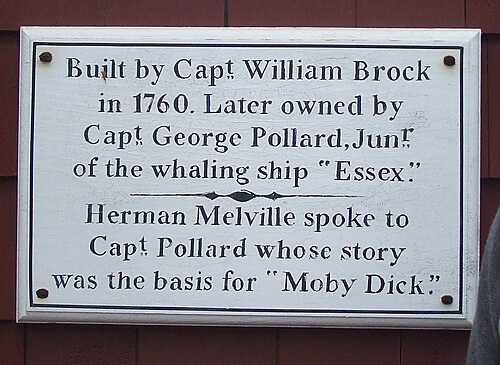
==reminds me of that Marine from WTC and the reviewer / or the obnoxious woman watching the Titanic—and the problem with “a little learning is a dangerous thing…” b/c _I’VE screwed up from that, too—chicken pox ALSO It’s just a big effing whale, m’dudes. The symbolism and all that—that’s CHARACTERIZATION—IT’S the way they see THEIR OWN journey through this story. ———Ahab is crazy for wanting to get revenge on a dumb animal, but it’s also crazy because it’s suicidal. The fact is, people die in the whale fishery all the time, and certain famous whales are often the culprit. ——THIS is a story based on reality - he’s even going to spoil the end of the book in his first chapter b/c he’s going to describe The Essex to us. There were two books written about it, one by the first mate (Narrative of the Most Extraordinary and Distressing Shipwreck of the Whale-Ship Essex - 1821, Owen Chase) and one by the cabin boy (The Loss of the Ship “Essex” Sunk by a Whale and the Ordeal of the Crew in Open Boats). Melville was inspired by the former, as the latter was not written for some twenty years after Moby Dick - then lost, found and ultimately published in 1984.==
First: Though most men have some vague flitting ideas of the general perils of the grand fishery, yet they have nothing like a fixed, vivid conception of those perils, and the frequency with which they recur. One reason perhaps is, that not one in fifty of the actual disasters and deaths by casualties in the fishery, ever finds a public record at home, however transient and immediately forgotten that record. Do you suppose that that poor fellow there, who this moment perhaps caught by the whale-line off the coast of New Guinea, is being carried down to the bottom of the sea by the sounding leviathan—do you suppose that that poor fellow’s name will appear in the newspaper obituary you will read to-morrow at your breakfast? No: because the mails are very irregular between here and New Guinea. In fact, did you ever hear what might be called regular news direct or indirect from New Guinea? Yet I tell you that upon one particular voyage which I made to the Pacific, among many others we spoke thirty different ships, every one of which had had a death by a whale, some of them more than one, and three that had each lost a boat’s crew. ==For God’s sake, be economical with your lamps and candles! not a gallon you burn, but at least one drop of man’s blood was spilled for it.==
==interesting b/c everyone back then lived MUCH closer to the food chain—except here where whaling takes place SO far away from everyone else - same thing could be said of Fast Fashion or iPhones. - how much pain/blood has been incurred for you to have that device? Which gets into questions of why most of the money made from selling these things goes to people who do not risk life/limb/blood. Hmmmmm So, really, truly, NOT AN ALLEGORY==
Secondly: People ashore have indeed some indefinite idea that a whale is an enormous creature of enormous power; but I have ever found that when narrating to them some specific example of this two-fold enormousness, they have significantly complimented me upon my facetiousness; when, I declare upon my soul, I had no more idea of being facetious than Moses, when he wrote the history of the plagues of Egypt.
But fortunately the special point I here seek can be established upon testimony entirely independent of my own. That point is this: The Sperm Whale is in some cases sufficiently powerful, knowing, and judiciously malicious, as with direct aforethought to stave in, utterly destroy, and sink a large ship; and what is more, the Sperm Whale has done it.
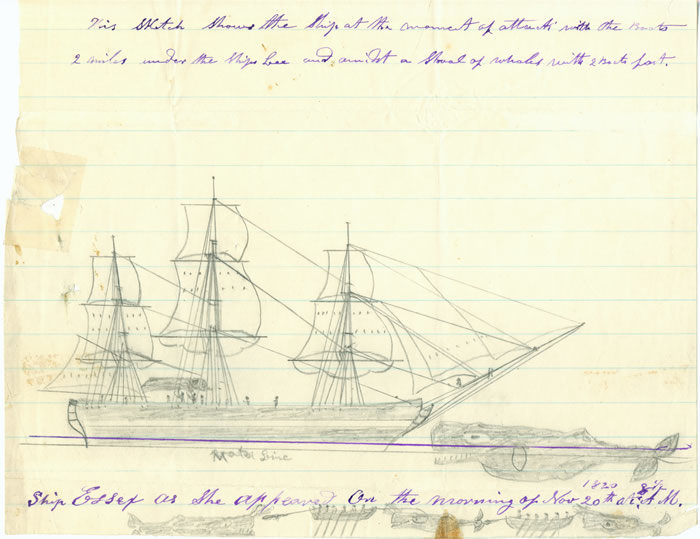
First: In the year 1820 the ship Essex,13 Captain Pollard, of Nantucket, was cruising in the Pacific Ocean. One day she saw spouts, lowered her boats, and gave chase to a shoal of sperm whales. Ere long, several of the whales were wounded; when, suddenly, a very large whale escaping from the boats, issued from the shoal, and bore directly down upon the ship. Dashing his forehead against her hull, he so stove her in, that in less than “ten minutes” she settled down and fell over. Not a surviving plank of her has been seen since. After the severest exposure, part of the crew reached the land in their boats. Being returned home at last, Captain Pollard once more sailed for the Pacific in command of another ship, but the gods shipwrecked him again upon unknown rocks and breakers; for the second time his ship was utterly lost, and forthwith forswearing the sea, he has never tempted it since. At this day Captain Pollard is a resident of Nantucket. I have seen Owen Chace, who was chief mate of the Essex at the time of the tragedy; I have read his plain and faithful narrative;14 I have conversed with his son; and all this within a few miles of the scene of15 the16 catastrophe.17
Secondly: The ship Union, also of Nantucket, was in the year 1807 totally lost off the Azores18 by a similar onset, but the authentic particulars of this catastrophe I have never chanced to encounter, though from the whale hunters I have now and then heard casual allusions to it.
Thirdly: Some eighteen or twenty years ago Commodore J——,19 then commanding an American sloop-of-war of the first class, happened to be dining with a party of whaling captains, on board a Nantucket ship in the harbor of Oahu, Sandwich Islands.20 Conversation turning upon whales, the Commodore was pleased to be sceptical touching the amazing strength ascribed to them by the professional gentlemen present. He peremptorily denied for example, that any whale could so smite his stout sloop-of-war as to cause her to leak so much as a thimbleful. Very good; but there is more coming. Some weeks after, the Commodore set sail in this impregnable craft for Valparaiso. But he was stopped on the way by a portly sperm whale, that begged a few moments’ confidential business with him. That business consisted in fetching the Commodore’s craft such a thwack, that with all his pumps going he made straight for the nearest port to heave down21 and repair. I am not superstitious, but I consider the Commodore’s interview with that whale as providential. Was not Saul of Tarsus converted from unbelief by a similar fright?22 I tell you, the sperm whale will stand no nonsense.
I will now refer you to Langsdorff’s Voyages23 for a little circumstance in point, peculiarly interesting to the writer hereof. Langsdorff, you must know by the way, was attached to the Russian Admiral Krusenstern’s24 famous Discovery Expedition in the beginning of the present century. Captain Langsdorff thus begins his seventeenth chapter:
“By the thirteenth of May our ship was ready to sail, and the next day we were out in the open sea, on our way to Ochotsh.25 The weather was very clear and fine, but so intolerably cold that we were obliged to keep on our fur clothing. For some days we had very little wind; it was not till the nineteenth that a brisk gale from the northwest sprang up. An uncommon large whale, the body of which was larger than the ship itself, lay almost at the surface of the water, but was not perceived by any one on board till the moment when the ship, which was in full sail, was almost upon him, so that it was impossible to prevent its striking against him. We were thus placed in the most imminent danger, as this gigantic creature, setting up its back, raised the ship three feet at least out of the water. The masts reeled, and the sails fell altogether, while we who were below all sprang instantly upon the deck, concluding that we had struck upon some rock; instead of this we saw the monster sailing off with the utmost gravity and solemnity. Captain D’Wolf26 applied immediately to the pumps27 to examine whether or not the vessel had received any damage from the shock, but we found that very happily it had escaped entirely uninjured.”
Now, the Captain D’Wolf here alluded to as commanding the ship in question, is a New Englander, who, after a long life of unusual adventures as a sea-captain, this day resides in the village of Dorchester near Boston. I have the honor of being a nephew of his.28 I have particularly questioned him concerning this passage in Langsdorff. He substantiates every word. The ship, however, was by no means a large one: a Russian craft built on the Siberian coast, and purchased by my uncle after bartering away the vessel in which he sailed from home.
In that up and down manly book of old-fashioned adventure, so full, too, of honest wonders—the voyage of Lionel Wafer,29 one of ancient Dampier’s30 old chums—I found a little matter set down so like that just quoted from Langsdorff, that I cannot forbear inserting it here for a corroborative example, if such be needed.
Lionel, it seems, was on his way to “John Ferdinando,” as he calls the modern Juan Fernandes.31 “In our way thither,” he says, “about four o’clock in the morning, when we were about one hundred and fifty leagues from the Main of America, our ship felt a terrible shock, which put our men in such consternation that they could hardly tell where they were or what to think; but every one began to prepare for death. And, indeed, the shock was so sudden and violent, that we took it for granted the ship had struck against a rock; but when the amazement was a little over, we cast the lead, and sounded, but found no ground. * * * * * The suddenness of the shock made the guns leap in their carriages, and several of the men were shaken out of their hammocks. Captain Davis, who lay with his head on a gun, was thrown out of his cabin!” Lionel then goes on to impute the shock to an earthquake, and seems to substantiate the imputation by stating that a great earthquake, somewhere about that time, did actually do great mischief along the Spanish land. But I should not much wonder if, in the darkness of that early hour of the morning, the shock was after all caused by an unseen whale vertically bumping the hull from beneath.
I might proceed with several more examples, one way or another known to me, of the great power and malice at times of the sperm whale. In more than one instance, he has been known, not only to chase the assailing boats back to their ships, but to pursue the ship itself, and long withstand all the lances hurled at him from its decks. The English ship Pusie Hall32 can tell a story on that head; and, as for his strength, let me say, that there have been examples where the lines attached to a running sperm whale have, in a calm, been transferred to the ship, and secured there; the whale towing her great hull through the water, as a horse walks off with a cart. Again, it is very often observed that, if the sperm whale, once struck, is allowed time to rally, he then acts, not so often with blind rage, as with wilful, deliberate designs of destruction to his pursuers; nor is it without conveying some eloquent indication of his character, that upon being attacked he will frequently open his mouth, and retain it in that dread expansion for several consecutive minutes. But I must be content with only one more and a concluding illustration; a remarkable and most significant one, by which you will not fail to see, that not only is the most marvellous event in this book corroborated by plain facts of the present day, but that these marvels (like all marvels) are mere repetitions of the ages; so that for the millionth time we say amen with Solomon—Verily there is nothing new under the sun.33
In the sixth Christian century lived Procopius, a Christian magistrate of Constantinople, in the days when Justinian was Emperor and Belisarius general.34 As many know, he wrote the history of his own times, a work every way of uncommon value. By the best authorities, he has always been considered a most trustworthy and unexaggerating historian, except in some one or two particulars, not at all affecting the matter presently to be mentioned.
Now, in this history of his, Procopius mentions that, during the term of his prefecture at Constantinople, a great sea-monster was captured in the neighboring Propontis, or Sea of Marmora,35 after having destroyed vessels at intervals in those waters for a period of more than fifty years. A fact thus set down in substantial history cannot easily be gainsaid. Nor is there any reason it should be. Of what precise species this sea-monster was, is not mentioned. But as he destroyed ships, as well as for other reasons, he must have been a whale; and I am strongly inclined to think a sperm whale. And I will tell you why. For a long time I fancied that the sperm whale had been always unknown in the Mediterranean and the deep waters connecting with it. Even now I am certain that those seas are not, and perhaps never can be, in the present constitution of things, a place for his habitual gregarious resort. But further investigations have recently proved to me, that in modern times there have been isolated instances of the presence of the sperm whale in the Mediterranean. I am told, on good authority, that on the Barbary coast, a Commodore Davis of the British navy found the skeleton of a sperm whale. Now, as a vessel of war readily passes through the Dardanelles,36 hence a sperm whale could, by the same route, pass out of the Mediterranean into the Propontis.
In the Propontis, as far as I can learn, none of that peculiar substance called brit is to be found, the aliment of the right whale. But I have every reason to believe that the food of the sperm whale—squid or cuttle-fish—lurks at the bottom of that sea, because large creatures, but by no means the largest of that sort, have been found at its surface. If, then, you properly put these statements together, and reason upon them a bit, you will clearly perceive that, according to all human reasoning, Procopius’s sea-monster, that for half a century stove the ships of a Roman Emperor, must in all probability have been a sperm whale.
NExt up - Musings on Ahab!, looking back, making sense of the crazy—especially WHY DID HE KEEP HUNTING WHALES THAT WERE NOT MOBY DICK?
CHAPTER 46. Surmises.
Though, consumed with the hot fire of his purpose, Ahab in all his thoughts and actions ever had in view the ultimate capture of Moby Dick; though he seemed ready to sacrifice all mortal interests to that one passion; nevertheless it may have been that he was by nature and long habituation far too wedded to a fiery whaleman’s ways, altogether to abandon the collateral prosecution of the voyage. Or at least if this were otherwise, there were not wanting other motives much more influential with him. It would be refining too much, perhaps, even considering his monomania, to hint that his vindictiveness towards the White Whale might have possibly extended itself in some degree to all sperm whales, and that the more monsters he slew by so much the more he multiplied the chances that each subsequently encountered whale would prove to be the hated one he hunted. But if such an hypothesis be indeed exceptionable, there were still additional considerations which, though not so strictly according with the wildness of his ruling passion, yet were by no means incapable of swaying him.
To accomplish his object Ahab must use tools; and of all tools used in the shadow of the moon, men are most apt to get out of order. He knew, for example, that however magnetic his ascendency in some respects was over Starbuck, yet that ascendency did not cover the complete spiritual man any more than mere corporeal superiority involves intellectual mastership; for to the purely spiritual, the intellectual but stand in a sort of corporeal relation. Starbuck’s body and Starbuck’s coerced will were Ahab’s, so long as Ahab kept his magnet at Starbuck’s brain; still he knew that for all this the chief mate, in his soul, abhorred his captain’s quest, and could he, would joyfully disintegrate himself from it, or even frustrate it. It might be that a long interval would elapse ere the White Whale was seen. During that long interval Starbuck would ever be apt to fall into open relapses of rebellion against his captain’s leadership, unless some ordinary, prudential, circumstantial influences were brought to bear upon him. Not only that, but the subtle insanity of Ahab respecting Moby Dick was noways more significantly manifested than in his superlative sense and shrewdness in foreseeing that, for the present, the hunt should in some way be stripped of that strange imaginative impiousness which naturally invested it; that the full terror of the voyage must be kept withdrawn into the obscure background (for few men’s courage is proof against protracted meditation unrelieved by action); that when they stood their long night watches, his officers and men must have some nearer things to think of than Moby Dick. For however eagerly and impetuously the savage crew had hailed the announcement of his quest; yet all sailors of all sorts are more or less capricious and unreliable—they live in the varying outer weather, and they inhale its fickleness—and when retained for any object remote and blank in the pursuit, however promissory of life and passion in the end, it is above all things requisite that temporary interests and employments should intervene and hold them healthily suspended for the final dash.
Nor was Ahab unmindful of another thing. In times of strong emotion mankind disdain all base considerations; but such times are evanescent. The permanent constitutional condition of the manufactured man, thought Ahab, is sordidness. Granting that the White Whale fully incites the hearts of this my savage crew, and playing round their savageness even breeds a certain generous knight-errantism in them, still, while for the love of it they give chase to Moby Dick, they must also have food for their more common, daily appetites. For even the high lifted and chivalric Crusaders of old times were not content to traverse two thousand miles of land to fight for their holy sepulchre,37 without committing burglaries, picking pockets, and gaining other pious perquisites by the way. Had they been strictly held to their one final and romantic object—that final and romantic object, too many would have turned from in disgust. I will not strip these men, thought Ahab, of all hopes of cash—aye, cash. They may scorn cash now; but let some months go by, and no perspective promise of it to them, and then this same quiescent cash all at once mutinying in them, this same cash would soon cashier Ahab.38
Nor was there wanting still another precautionary motive more related to Ahab personally. Having impulsively, it is probable, and perhaps somewhat prematurely revealed the prime but private purpose of the Pequod’s voyage, Ahab was now entirely conscious that, in so doing, he had indirectly laid himself open to the unanswerable charge of usurpation; and with perfect impunity, both moral and legal, his crew if so disposed, and to that end competent, could refuse all further obedience to him, and even violently wrest from him the command. From even the barely hinted imputation of usurpation, and the possible consequences of such a suppressed impression gaining ground, Ahab must of course have been most anxious to protect himself. That protection could only consist in his own predominating brain and heart and hand, backed by a heedful, closely calculating attention to every minute atmospheric influence which it was possible for his crew to be subjected to.
For all these reasons then, and others perhaps too analytic to be verbally developed here,39 Ahab plainly saw that he must still in a good degree continue true to the natural, nominal purpose of the Pequod’s voyage; observe all customary usages; and not only that, but force himself to evince all his well known passionate interest in the general pursuit of his profession.
Be all this as it may, his voice was now often heard hailing the three mast-heads and admonishing them to keep a bright look-out, and not omit reporting even a porpoise. This vigilance was not long without reward.
==BJ: 09:01:01
CHAPTER 47. The Mat-Maker.
It was a cloudy, sultry afternoon; the seamen were lazily lounging about the decks, or vacantly gazing over into the lead-coloured waters. Queequeg and I were mildly employed weaving what is called a sword-mat, for an additional lashing to our boat.40 So still and subdued and yet somehow preluding was all the scene, and such an incantation of reverie lurked in the air, that each silent sailor seemed resolved into his own invisible self.
 weaving sword/beater
I was the attendant or page of Queequeg, while busy at the mat. As I kept passing and repassing the filling or woof of marline41 between the long yarns of the warp, using my own hand for the shuttle, and as Queequeg, standing sideways, ever and anon slid his heavy oaken sword between the threads, and idly looking off upon the water, carelessly and unthinkingly drove home every yarn:42 I say so strange a dreaminess did there then reign all over the ship and all over the sea, only broken by the intermitting dull sound of the sword, that it seemed as if this were the Loom of Time, and I myself were a shuttle mechanically weaving and weaving away at the Fates.43 There lay the fixed threads of the warp subject to but one single, ever returning, unchanging vibration, and that vibration merely enough to admit of the crosswise interblending of other threads with its own. This warp seemed necessity;44 and here, thought I, with my own hand I ply my own shuttle and weave my own destiny into these unalterable threads. Meantime, Queequeg’s impulsive, indifferent sword, sometimes hitting the woof slantingly, or crookedly, or strongly, or weakly, as the case might be; and by this difference in the concluding blow producing a corresponding contrast in the final aspect of the completed fabric; this savage’s sword, thought I, which thus finally shapes and fashions both warp and woof; this easy, indifferent sword must be chance—aye, chance, free will, and necessity—nowise incompatible—all interweavingly working together. The straight warp of necessity, not to be swerved from its ultimate course—its every alternating vibration, indeed, only tending to that; free will still free to ply her shuttle between given threads; and chance, though restrained in its play within the right lines of necessity, and sideways in its motions directed by free will, though thus prescribed to by both, chance by turns rules either, and has the last featuring blow at events.
* * * * *
Thus we were weaving and weaving away when I started at a sound so strange, long drawn, and musically wild and unearthly, that the ball of free will45 dropped from my hand, and I stood gazing up at the clouds whence that voice dropped like a wing. High aloft in the cross-trees was that mad Gay-Header, Tashtego. His body was reaching eagerly forward, his hand stretched out like a wand, and at brief sudden intervals he continued his cries. To be sure the same sound was that very moment perhaps being heard all over the seas, from hundreds of whalemen’s look-outs perched as high in the air; but from few of those lungs could that accustomed old cry have derived such a marvellous cadence as from Tashtego the Indian’s.
As he stood hovering over you half suspended in air, so wildly and eagerly peering towards the horizon, you would have thought him some prophet or seer beholding the shadows of Fate, and by those wild cries announcing their coming.
“There she blows! there! there! there! she blows! she blows!”
“Where-away?”
“On the lee-beam,46 about two miles off! a school of them!”
Instantly all was commotion.
The Sperm Whale blows as a clock ticks, with the same undeviating and reliable uniformity. And thereby whalemen distinguish this fish from other tribes of his genus.
“There go flukes!”47 was now the cry from Tashtego; and the whales disappeared.
“Quick, steward!” cried Ahab. “Time! time!”
Dough-Boy hurried below, glanced at the watch, and reported the exact minute to Ahab.48
The ship was now kept away from the wind, and she went gently rolling before it. Tashtego reporting that the whales had gone down heading to leeward, we confidently looked to see them again directly in advance of our bows. For that singular craft at times evinced by the Sperm Whale when, sounding with his head in one direction, he nevertheless, while concealed beneath the surface, mills round, and swiftly swims off in the opposite quarter—this deceitfulness of his could not now be in action; for there was no reason to suppose that the fish seen by Tashtego had been in any way alarmed, or indeed knew at all of our vicinity. One of the men selected for shipkeepers—that is, those not appointed to the boats, by this time relieved the Indian at the main-mast head. The sailors at the fore and mizzen had come down; the line tubs were fixed in their places; the cranes49 were thrust out; the mainyard50 was backed, and the three boats swung over the sea like three samphire51 baskets over high cliffs. Outside of the bulwarks their eager crews with one hand clung to the rail, while one foot was expectantly poised on the gunwale. So look the long line of man-of-war’s men about to throw themselves on board an enemy’s ship.
But at this critical instant a sudden exclamation was heard that took every eye from the whale. With a start all glared at dark Ahab, who was surrounded by five dusky phantoms that seemed fresh formed out of air.
Back to Contents
==Have notes to add? Email me heather@craftlit.com or call 1-206-350-1642 or use speakpipe.com/craftlit.==
Footnotes
Footnotes
-
Rinaldo Rinaldini: the bandit-hero of a series of German novels very popular around 1800. Rinaldini was a sort of Corsican Robin Hood ↩
-
Timor Tom: a rogue sperm whale in Indonesia ↩
-
Oriental straits of that name: the Timor Passage, which flows from the Pacific Ocean to the Indian Ocean ↩
-
Ombay: an island north of the Timor Passage ↩
-
New Zealand Jack: a rogue sperm whale ↩
-
The Tattoo Land: New Zealand, where the aboriginal people tattooed themselves ↩
-
Morquan: a rogue sperm whale, possibly invented by Melville ↩
-
Don Miguel: a rogue sperm whale, possibly invented by Melville ↩
-
Marius or Sylla: Gaius Marius (157 B.C.-86 B.C.) and Lucius Cornelius Sulla (c. 138 B.C.-78 B.C.), two Roman generals who fought against each other in a civil war ↩
-
Annawon: a figure in King Philip’s War, whose capture and execution in 1676 ended the war ↩
-
Indian King Philip: chief Metacomet, who led his people in a disastrous war against British settlers from 1675-76 ↩
-
The ship Essex: a real-life whaling ship sunk by a whale off the Pacific coast of South America in a widely known incident in 1820. Some crew members survived in whaleboats for months by resorting to cannibalism ↩
-
Faithful narrative: Chase’s 1821 book, Narrative of the Most Extraordinary and Distressing Ship-Wreck of the Whale-Ship Essex ↩
-
Melville’s Footnotes are not in BJ’s recording. Melville’s footnote: *The following are extracts from Chace’s narrative: “Every fact seemed to warrant me in concluding that it was anything but chance which directed his operations; he made two several attacks upon the ship, at a short interval between them, both of which, according to their direction, were calculated to do us the most injury, by being made ahead, and thereby combining the speed of the two objects for the shock; to effect which, the exact manœuvres which he made were necessary. His aspect was most horrible, and such as indicated resentment and fury… ↩
-
He came directly from the shoal which we had just before entered, and in which we had struck three of his companions, as if fired with revenge for their sufferings.” Again: “At all events, the whole circumstances taken together, all happening before my own eyes, and producing, at the time, impressions in my mind of decided, calculating mischief, on the part of the whale (many of which impressions I cannot now recall), induce me to be satisfied that I am correct in my opinion.”* ↩
-
Second Footnote: Here are his reflections some time after quitting the ship, during a black night in an open boat, when almost despairing of reaching any hospitable shore. “The dark ocean and swelling waters were nothing; the fears of being swallowed up by some dreadful tempest, or dashed upon hidden rocks, with all the other ordinary subjects of fearful contemplation, seemed scarcely entitled to a moment’s thought; the dismal looking wreck, and the horrid aspect and revenge of the whale, wholly engrossed my reflections, until day again made its appearance…” In another place—p. 45,—he speaks of “the mysterious and mortal attack of the animal.” ↩
-
Commodore J: thought to be Commodore Thomas ap Catesby Jones (1790-1858) ↩
-
Sandwich Islands: Hawaii ↩
-
Heave down: tip a vessel over to clean or repair the bottom ↩
-
Acts 9:3-4, 6: Saul was out persecuting new Christians then, on the road to Damascus, a bright light temporarily blinded him, and he heard the voice of Jesus. He changed his name to Paul and his religion, too. ↩
-
Langsdorff’s Voyages: Voyages and Travels in Various Parts of the World During the Years 1803, 1804, 1805, 1806, and 1807, by the Prussian aristocrat Grigori Ivanovitch Langsdorff ↩
-
Russian Admiral Krusenstern: Adam Johann von Krusenstern (1770-1846); Discovery Expedition: a two-ship voyage from 1803 to 1806 that became the first Russian circumnavigation of the globe ↩
-
Ochotsh: Okhotsk, a seaport on the Pacific coast of Russia ↩
-
Captain D’Wolf: Captain John D’Wolf II (1779-1872) ↩
-
The pumps: that is, bilge-pumps, used to remove water that collects in the very bottom of the ship ↩
-
A nephew of his: John D’Wolf married the sister of Herman Melville’s (not Ishmael’s) father. SO THIS CHAPTER IS MELVILLE TALKING - amiright? ↩
-
Lionel Wafer: a Welsh explorer and buccaneer, 1640-1705 ↩
-
Ancient Dampier: William Dampier (1651-1715), an English buccaneer and the first person to sail around the world three times ↩
-
Juan Fernandes: the Juan Fernandez Islands off the coast of Chile ↩
-
Pusie Hall: a ship sunk by a whale in 1835 ↩
-
Ecclesiastes 1:9,traditionally believed to have been written by King Solomon, says “there is no new thing under the sun.” ↩
-
Procopius: a Roman historian (c. 500-c. 565); Justinian: Justinian I (c. 482-565), an Eastern Roman Emperor; Belisarius: Flavius Belisarius (c. 505-565), a general of the Byzantine Empire ↩
-
Sea of Marmora: an inland sea in Turkey that connects the Black Sea to the Aegean Sea ↩
-
Barbary coast: the middle and western regions of the coast of North Africa; Dardanelles: a narrow strait in northwestern Turkey that connects the Aegean Sea to the Sea of Marmora ↩
-
Knight-errantism: having the qualities of a knight who wanders in search of adventures to prove his valor, courtesy, and honor; Crusaders: European Christians from the 11th, 12th, and 13th centuries who made military expeditions to modern-day Israel to reclaim the Holy Land from Muslim control; Holy sepulchre: Christ’s tomb ↩
-
Cashier: do away with ↩
-
HA! For all these reasons and geez guys, probably others too, but c’mon. I’ve given you enough, right? ↩
-
apparently these mats were “used as cushion’s when two heavy wooden spars come in contact with one another”; spars are the general term for essential poles (like masts, yards, booms, gaffs, bowsprits) that support, shape, and control sails on a sailing vessel) ↩
-
marline - loosely plied cord - it would be more sproingy, good for cushioning. ↩
-
beating the weft; I can attest to this frame of mind while weaving. It’s VERY meditative. ↩
-
Loom of Time: a metaphor for the shaping of earthly events found, among other places, in Goethe’s Faust; The Fates: in Greek mythology, three goddesses who spin, measure, and cut the thread of life ↩
-
warp=necessity. You have nothing without it. It’s the building block of life, of time. It’s straight. It’s always the same, but the weft—chance—can be wonky or straight…but it must keep moving and adding on to the whole cloth. ↩
-
Okay, I just love this! “Ball of Free Will” sub-references The Fates, but also the sound that he hears is so riveting that he dropped the yarn/rope that he was weaving with, but ALSO this is the big moment of change where the “free will” the men had aboard the ship when they didn’t have an assigned job has been cut short by Tashtego’s sighting a whale! ↩
-
On the lee-beam: directly on the side of the ship towards which the wind is blowing ↩
-
flukes: whale tails, when they come up, it means the whale is diving down. ↩
-
exact minute: because as we learned before, those log books must be accurate. ↩
-
Cranes: that is, for lowering the whaleboats into the water ↩
-
Mainyard: on the mainmast, the pole used to spread and support the top of the principal sail ↩
-
sam·phire noun: European plant of the parsley family that grows on rocks and cliffs by the sea. Its aromatic, fleshy leaves were formerly much used in pickles; reference from King Lear 4.6.14-15: Halfway down [a cliff] hangs one that gathers samphire, dreadful trade” ↩