| PREVIOUS chapter | NEXT chapter | ||
|---|---|---|---|
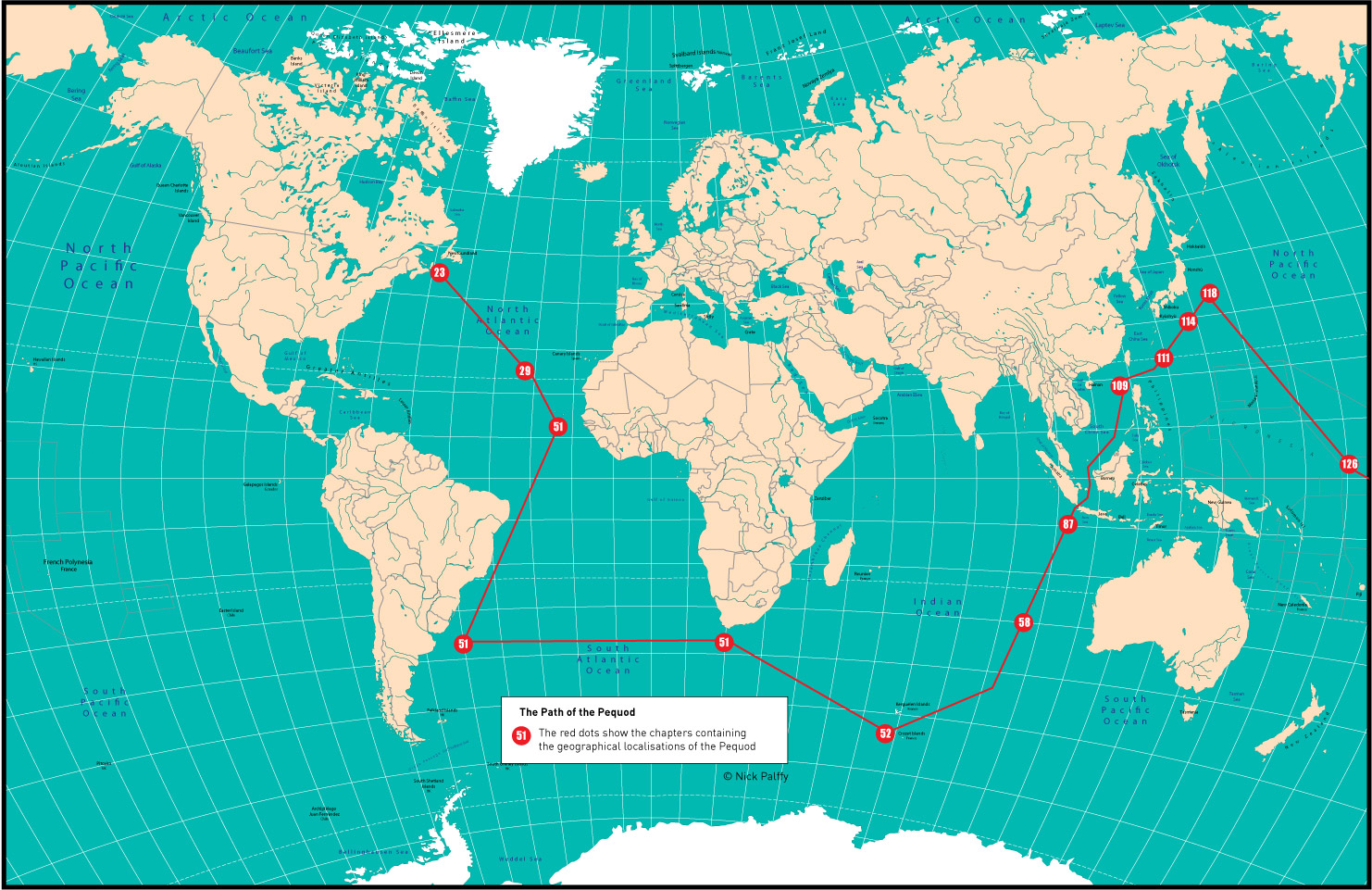
| You may want to refer to the Pequod’s Map for this one |
Contents
CHAPTER 44. The Chart. FOOTNOTES
CHAPTER 44. The Chart.
Had you followed Captain Ahab down into his cabin after the squall that took place on the night succeeding that wild ratification of his purpose with his crew, you would have seen him go to a locker in the transom, and bringing out a large wrinkled roll of yellowish sea charts, spread them before him on his screwed-down table. Then seating himself before it, you would have seen him intently study the various lines and shadings which there met his eye; and with slow but steady pencil trace additional courses over spaces that before were blank. At intervals, he would refer to piles of old log-books beside him, wherein were set down the seasons and places in which, on various former voyages of various ships, sperm whales had been captured or seen.
While thus employed, the heavy pewter lamp suspended in chains over his head, continually rocked with the motion of the ship, and for ever threw shifting gleams and shadows of lines upon his wrinkled brow, till it almost seemed that while he himself was marking out lines and courses on the wrinkled charts, some invisible pencil was also tracing lines and courses upon the deeply marked chart of his forehead.
But it was not this night in particular that, in the solitude of his cabin, Ahab thus pondered over his charts. Almost every night they were brought out; almost every night some pencil marks were effaced, and others were substituted. For with the charts of all four oceans1 before him, Ahab was threading a maze of currents and eddies, with a view to the more certain accomplishment of that monomaniac thought of his soul.
Now, to any one not fully acquainted with the ways of the leviathans, it might seem an absurdly hopeless task thus to seek out one solitary creature in the unhooped oceans2 of this planet. But not so did it seem to Ahab, who knew the sets of all tides and currents; and thereby calculating the driftings of the sperm whale’s food;3 and, also, calling to mind the regular, ascertained seasons for hunting him in particular latitudes; could arrive at reasonable surmises, almost approaching to certainties, concerning the timeliest day to be upon this or that ground in search of his prey.
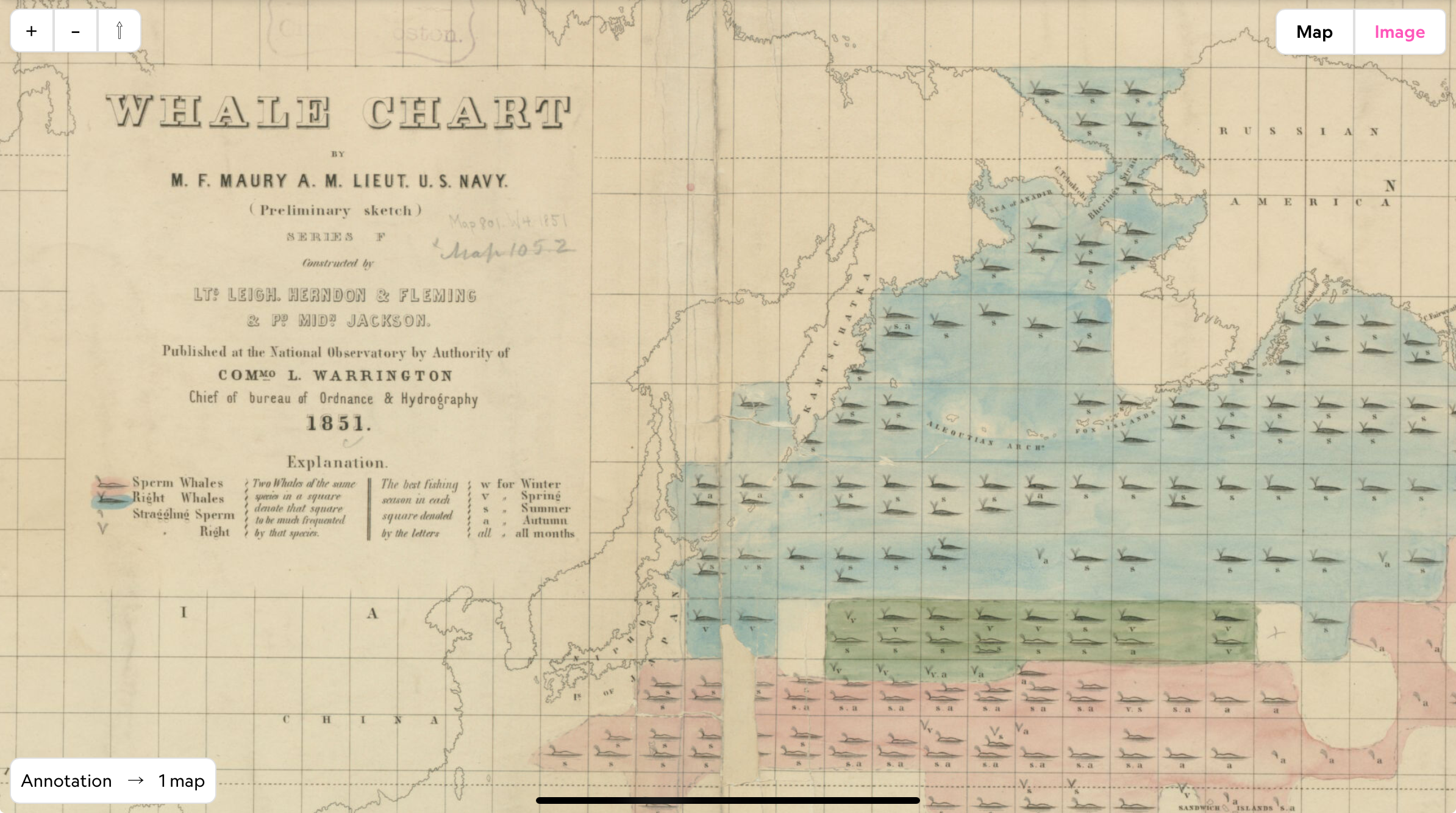
So assured, indeed, is the fact concerning the periodicalness of the sperm whale’s resorting to given waters, that many hunters believe that, could he be closely observed and studied throughout the world; were the logs for one voyage of the entire whale fleet carefully collated, then the migrations of the sperm whale would be found to correspond in invariability to those of the herring-shoals or the flights of swallows. On this hint, attempts have been made to construct elaborate migratory charts of the sperm whale.4*
 *Since the above was written, the statement is happily borne
 out by an official circular, issued by Lieutenant Maury, of
 the National Observatory, Washington, April 16th, 1851. By
 that circular, it appears that precisely such a chart is in
 course of completion; and portions of it are presented in
 the circular. “This chart divides the ocean into districts
 of five degrees of latitude by five degrees of longitude;
 perpendicularly through each of which districts are twelve
 columns for the twelve months; and horizontally through each
 of which districts are three lines; one to show the number
 of days that have been spent in each month in every
 district, and the two others to show the number of days in
 which whales, sperm or right, have been seen.”
Besides, when making a passage from one feeding-ground to another, the sperm whales, guided by some infallible instinct—say, rather, secret intelligence from the Deity—mostly swim in veins, as they are called; continuing their way along a given ocean-line with such undeviating exactitude, that no ship ever sailed her course, by any chart, with one tithe5 of such marvellous precision. Though, in these cases, the direction taken by any one whale be straight as a surveyor’s parallel, and though the line of advance be strictly confined to its own unavoidable, straight wake, yet the arbitrary vein in which at these times he is said to swim, generally embraces some few miles in width (more or less, as the vein is presumed to expand or contract); but never exceeds the visual sweep from the whale-ship’s mast-heads, when circumspectly gliding along this magic zone. The sum is, that at particular seasons within that breadth and along that path, migrating whales may with great confidence be looked for.
And hence not only at substantiated times, upon well known separate feeding-grounds, could Ahab hope to encounter his prey; but in crossing the widest expanses of water between those grounds he could, by his art, so place and time himself on his way, as even then not to be wholly without prospect of a meeting.
There was a circumstance which at first sight seemed to entangle his delirious but still methodical scheme. But not so in the reality, perhaps. Though the gregarious sperm whales have their regular seasons for particular grounds, yet in general you cannot conclude that the herds which haunted such and such a latitude or longitude this year, say, will turn out to be identically the same with those that were found there the preceding season; though there are peculiar and unquestionable instances where the contrary of this has proved true. In general, the same remark, only within a less wide limit, applies to the solitaries and hermits among the matured, aged sperm whales. So that though Moby Dick had in a former year been seen, for example, on what is called the Seychelle6 ground in the Indian ocean, or Volcano Bay on the Japanese Coast;7 yet it did not follow, that were the Pequod to visit either of those spots at any subsequent corresponding season, she would infallibly encounter him there. So, too, with some other feeding grounds, where he had at times revealed himself. But all these seemed only his casual stopping-places and ocean-inns, so to speak, not his places of prolonged abode. And where Ahab’s chances of accomplishing his object have hitherto been spoken of, allusion has only been made to whatever way-side, antecedent, extra prospects were his, ere a particular set time or place were attained, when all possibilities would become probabilities, and, as Ahab fondly thought, every possibility8 the next thing to a certainty.9 That particular set time and place were conjoined in the one technical phrase—the Season-on-the-Line.10 For there and then, for several consecutive years, Moby Dick had been periodically descried, lingering in those waters for awhile, as the sun, in its annual round, loiters for a predicted interval in any one sign of the Zodiac.11 There it was, too, that most of the deadly encounters with the white whale had taken place; there the waves were storied with his deeds; there also was that tragic spot where the monomaniac old man had found the awful motive to his vengeance. But in the cautious comprehensiveness and unloitering vigilance with which Ahab threw his brooding soul into this unfaltering hunt, he would not permit himself to rest all his hopes upon the one crowning fact above mentioned, however flattering it might be to those hopes; nor in the sleeplessness of his vow could he so tranquillize his unquiet heart as to postpone all intervening quest.
Now, the Pequod had sailed from Nantucket at the very beginning of the Season-on-the-Line. No possible endeavor then could enable her commander to make the great passage southwards, double12 Cape Horn, and then running down sixty degrees of latitude13 arrive in the equatorial Pacific in time to cruise there. Therefore, he must wait for the next ensuing season. Yet the premature hour of the Pequod’s sailing had, perhaps, been correctly selected by Ahab,14 with a view to this very complexion of things. Because, an interval of three hundred and sixty-five days and nights was before him; an interval which, instead of impatiently enduring ashore, he would spend in a miscellaneous hunt; if by chance the White Whale, spending his vacation in seas far remote from his periodical feeding-grounds, should turn up his wrinkled brow off the Persian Gulf, or in the Bengal Bay, or China Seas, or in any other waters haunted by his race. So that Monsoons, Pampas,15 Nor’-Westers, Harmattans,16 Trades; any wind but the Levanter and Simoon,17 might blow Moby Dick into the devious zig-zag world-circle of the Pequod’s circumnavigating wake.
But granting all this; yet, regarded discreetly and coolly, seems it not but a mad idea, this; that in the broad boundless ocean, one solitary whale, even if encountered, should be thought capable of individual recognition from his hunter, even as a white-bearded Mufti18 in the thronged thoroughfares of Constantinople? Yes.19 For the peculiar snow-white brow of Moby Dick, and his snow-white hump, could not but be unmistakable. And have I not tallied20 the whale, Ahab would mutter to himself, as after poring over his charts till long after midnight he would throw himself back in reveries—tallied him, and shall he escape? His broad fins are bored, and scalloped out like a lost sheep’s ear!21 And here, his mad mind would run on in a breathless race; till a weariness and faintness of pondering came over him; and in the open air of the deck he would seek to recover his strength. Ah, God! what trances of torments does that man endure who is consumed with one unachieved revengeful desire. He sleeps with clenched hands; and wakes with his own bloody nails in his palms.
Often, when forced from his hammock by exhausting and intolerably vivid dreams of the night, which, resuming his own intense thoughts through the day, carried them on amid a clashing of phrensies, and whirled them round and round and round in his blazing brain, till the very throbbing of his life-spot22 became insufferable anguish; and when, as was sometimes the case, these spiritual throes in him heaved his being up from its base, and a chasm seemed opening in him, from which forked flames and lightnings shot up, and accursed fiends beckoned him to leap down among them; when this hell in himself yawned beneath him,23 a wild cry would be heard through the ship; and with glaring eyes Ahab would burst from his state room, as though escaping from a bed that was on fire. Yet these, perhaps, instead of being the unsuppressable symptoms of some latent weakness, or fright at his own resolve, were but the plainest tokens of its intensity. For, at such times, crazy Ahab, the scheming, unappeasedly steadfast hunter of the white whale; this Ahab that had gone to his hammock, was not the agent that so caused him to burst from it in horror again. The latter was the eternal, living principle or soul in him; and in sleep, being for the time dissociated from the characterizing mind, which at other times employed it for its outer vehicle or agent, it spontaneously sought escape from the scorching contiguity of the frantic thing, of which, for the time, it was no longer an integral. But as the mind does not exist unless leagued with the soul, therefore it must have been that, in Ahab’s case, yielding up all his thoughts and fancies to his one supreme purpose; that purpose, by its own sheer inveteracy24 of will, forced itself against gods and devils into a kind of self-assumed, independent being of its own. Nay, could grimly live and burn, while the common vitality to which it was conjoined, fled horror-stricken from the unbidden and unfathered birth.25 Therefore, the tormented spirit that glared out of bodily eyes, when what seemed Ahab rushed from his room, was for the time but a vacated thing, a formless somnambulistic being, a ray of living light, to be sure, but without an object to colour, and therefore a blankness in itself. God help thee, old man, thy thoughts have created a creature in thee; and he whose intense thinking thus makes him a Prometheus;26 a vulture feeds upon that heart for ever; that vulture the very creature he creates. Back to Contents
==Have notes to add? Email me heather@craftlit.com or call 1-206-350-1642 or use speakpipe.com/craftlit.==
Footnotes
Footnotes
-
All four oceans: the Atlantic, Pacific, Indian, and Arctic oceans ↩
-
unhooped oceans: lovely visual metaphor, think of the hoops of a barrel loosening and letting the waters run. ↩
-
sperm whale’s food: we now know this is often deep water squid, but I don’t think they knew about those squids (as real things) back in 1851. ↩
-
one tithe: ten percent. ↩
-
“Seychelle” is an error. The islands were named after Jean Moreau de Séchelles, and should always have a final ‘s’. The Seychelles,are an archipelago in the Indian Ocean, northeast of Madagascar off the east coast of Africa ↩
-
Volcano Bay: Uchiura Bay in Hokkaido, northern Japan ↩
-
when all possibilities would become probabilities, and, as Ahab fondly thought, every possibility the next thing to a certainty.: ↩
-
Like magical thinking - or believing that THIS time you’ll win the lottery. ;) ↩
-
The Season-on-the-Line is the best time of year to go whaling; equator = line, Pacific ocean season runs from approximately December 22 (Winter Solstice in the Northern Hemisphere), when the sun is overhead on the Tropic of Capricorn (23°30’S) to June 21 (Summer Solstice), when the sun is overhead on the Tropic of Cancer (23°30’N). ↩
-
loiters … in any one sign of the Zodiac: A narrow belt of sky in which the sun, moon, and planets seem to rise and set, the zodiac is traditionally divided into twelve sectors, each related to a constellation and an astrological sign. As the earth moves around the sun, the line-up of constellations also appears to move every night, so that over the course of a month one constellation rises along the zodiacal belt (visible in the night sky), and another sets (becoming invisible because of daylight). From this daytime perspective, it may be said, astronomically, that during each month the sun obscures a particular constellation, or, astrologically, that the sun inhabits the “house” of that constellation’s “sign,” or, in Ishmael’s terms, the sun “loiters for a predicted interval in any one sign of the Zodiac.” In Ch. 99, Stubb uses the zodiac in his reading of the doubloon. (from Melville Electronic Library) ↩
-
double: go around. ↩
-
running down sixty degrees of latitude: this may feel a little like in the UK everyone goes UP to London and DOWN to everywhere else, but it makes sense numerically: sailing “down” would be heading north in the Pacific for 60 degrees from Cape Horn toward the Equator. ↩
-
Though Ishmael states that Ahab chose the December departure, it is more likely the owners did. In any case, he could clearly not arrive in the prime whaling areas in time for that season. So rather than round Cape Horn, he went around the Cape of Good Hope and then via the Persian Gulf, Bengal Bay, and the China Seas, whaling along the way and collecting information about Moby Dick. ↩
-
Pampas are plains, not winds. Oops. ↩
-
Harmattan: a dry and dusty West African wind ↩
-
The Levanter is an easterly wind that blows in the western Mediterranean Sea. The Simoom is a dry, dust-laden wind in the lands east of the Mediterranean Sea. Since Moby Dick is unlikely to be found in the Mediterranean Sea, these winds are unlikely to blow him into the Pequod’s path. ↩
-
A Mufti is a Sunni Islamic scholar who interprets Sharia law. Keeping a beard is required in Sunni Islam, so Muftis (who are probably older men) would naturally be white-bearded. ↩
-
Yes.: Ishmael asks a question **seems it not but a mad idea, this; ↩
-
tallied: put my mark on the whale ↩
-
Bored: cut through with holes. “His broad fins are bored, and scalloped out like a lost sheep’s ear!” I assume this refers to the idea that a lost sheep will get its ears caught and ripped on thorns and shrubs, since if a sheep were actually attacked by a predator, the scalloped ear would be the least of its problems. ↩
-
Life-spot: in this case, heart. A whale’s “life-spot” is an internal mass of coiled arteries that, when pierced by a lance aimed behind the fin, cause rapid death ↩
-
this hell in himself: the phrase echoes Sir Thomas Browne’s “I feel sometimes a hell within myself” (Religio Medici, Part 1, Sec. 51), which Melville read in his copy of Sir Thomas Browne’s Works. See also Satan’s “myself am Hell” in Milton’s Paradise Lost (IV, 75) and the note on “damned in the midst of Paradise” in Ch. 37. ↩
-
Inveteracy: persistence ↩
-
REVISION NARRATIVE: unbidden and unfathered birth // Perhaps the most laughable typo in the British edition is the alteration of “unfathered birth” to unfeathered birth,” which conjures up the image of Ahab as a plucked fowl. The absurd image could not be more poorly placed, as it ruins the serious tone of Ahab’s desperate night terrors. The change is doubly unfortunate for, despite its unintended absurdity, the association with an unfledged or new-born bird still lacking flight feathers is plausible enough so that British readers might not recognize it as an error. Moreover, those finding it odd would not readily guess at the intended spelling, “unfathered birth,” which, among mammals, is unlikely. ↩
-
Prometheus: in Greek mythology, a Titan who steals fire from the gods and is punished by being chained to a rock and having his liver (not heart) eaten out daily by an eagle. ↩